




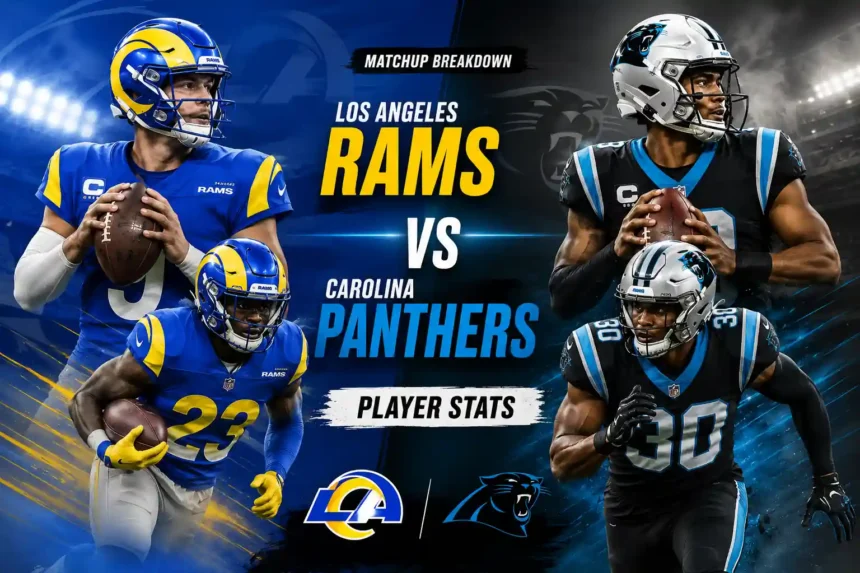
The latest Los Angeles Rams vs Carolina Panthers match player stats come from their NFC Wild Card meeting on January 10, 2026. Los Angeles won 34–31 after Matthew Stafford completed a 71-yard winning drive with a 19-yard touchdown pass to Colby Parkinson. Matthew Stafford finished with 304 passing yards and three touchdown passes, while Puka Nacua totaled 111 receiving yards and scored two touchdowns. Carolina quarterback Bryce Young threw for 264 yards, and Jalen Coker led all receivers with 134 yards.
- Rams vs Panthers Match Summary
- Los Angeles Rams vs Carolina Panthers Match Player Stats
- Receiving Statistics
- Defensive and Special-Teams Impact
- Complete Team-Stat Comparison
- How the Rams Won the Wild Card Game
- Early Pressure Created a 14–0 Lead
- Carolina Shifted the Game Toward Its Playmakers
- Stafford Delivered When the Result Was at Risk
- How the Playoff Game Compared With the November Meeting
- Most Influential Player Performances
- Matthew Stafford: Decisive Rather Than Flawless
- Puka Nacua: Production in Two Roles
- Bryce Young: Competitive Despite Uneven Efficiency
- Jalen Coker: Carolina’s Biggest Downfield Threat
- What the Statistics Reveal
- More Sports Profiles: Phoenix Mercury vs Connecticut Sun Match Player Stats
- Conclusion
- Frequently Asked Questions
- 1. Who won the latest Rams vs Panthers game?
- 2. What were Matthew Stafford’s stats against Carolina?
- 3. What were Bryce Young’s playoff stats against the Rams?
- 4. Who had the most receiving yards?
- 5. Who scored touchdowns for the Rams?
- 6. Who scored Carolina’s touchdowns?
- 7. Which team recorded more total yards?
- 8. What was the game-winning play?
Rams vs Panthers Match Summary
The playoff game at Bank of America Stadium produced four lead changes or ties during the second half. Los Angeles opened a 14–0 advantage, but Carolina recovered and eventually moved ahead 31–27 with 2:39 remaining.
Stafford responded by completing six of seven attempts on the Rams’ final possession. His last pass was a 19-yard touchdown to Parkinson with 38 seconds left, giving Los Angeles the decisive 34–31 lead.
| Match detail | Result |
| Competition | NFC Wild Card Round |
| Date | January 10, 2026 |
| Venue | Bank of America Stadium, Charlotte |
| Final score | Rams 34, Panthers 31 |
| Halftime score | Rams 17, Panthers 14 |
| Winning touchdown | Stafford to Colby Parkinson, 19 yards |
| Time remaining after winning score | 38 seconds |
| Total yards | Rams 411, Panthers 333 |
| Turnovers | Rams 1, Panthers 2 |
The Rams and Panthers each registered 21 first downs and four touchdowns. Los Angeles gained 78 more total yards and held the ball for 31:46, compared with Carolina’s 28:14.
Los Angeles Rams vs Carolina Panthers Match Player Stats
Quarterback Statistics
| Player | Completions/Attempts | Passing yards | TD | INT | Rating |
| Matthew Stafford, Rams | 24/42 | 304 | 3 | 1 | 93.8 |
| Bryce Young, Panthers | 21/40 | 264 | 1 | 1 | 71.3 |
Stafford attempted two more passes than he had completions and attempts combined in several low-volume Rams games, but the heavier workload ultimately produced three touchdown passes. His scoring throws went to Nacua, Kyren Williams, and Parkinson.
Young completed 52.5% of his passes. His only passing touchdown was a seven-yard connection with Coker that put Carolina ahead late in the fourth quarter. Young also added a 16-yard rushing touchdown before halftime.
The individual passing totals differ from the team’s net passing totals because team figures subtract yardage lost on sacks. Stafford recorded 304 individual passing yards while Los Angeles finished with 295 net passing yards. Young posted 264 individual yards while Carolina had 250 net passing yards.
Rams Rushing Leaders
| Player | Carries | Yards | Average | TD | Long |
| Kyren Williams | 13 | 57 | 4.4 | 0 | 8 |
| Blake Corum | 11 | 45 | 4.1 | 0 | 8 |
| Puka Nacua | 3 | 14 | 4.7 | 1 | 5 |
| Matthew Stafford | 2 | 0 | 0.0 | 0 | 2 |
Williams and Corum gave Los Angeles a balanced backfield, combining for 102 yards on 24 carries. Neither running back scored on the ground, but Williams caught a 13-yard touchdown pass during the fourth quarter.
Nacua supplied the Rams’ only rushing touchdown on a five-yard run that gave Los Angeles an early 14–0 lead.
Panthers Rushing Leaders
| Player | Carries | Yards | Average | TD | Long |
| Chuba Hubbard | 13 | 46 | 3.5 | 2 | 8 |
| Bryce Young | 3 | 24 | 8.0 | 1 | 16 |
| Rico Dowdle | 5 | 9 | 1.8 | 0 | 8 |
| Trevor Etienne | 1 | 4 | 4.0 | 0 | 4 |
Carolina rushed for only 83 team yards, but its ground game produced three touchdowns. Hubbard scored from one and three yards, while Young’s 16-yard scramble reduced the Rams’ lead to 17–14 shortly before halftime.
Hubbard’s efficiency was modest at 3.5 yards per carry, yet his performance remained valuable because Carolina converted every red-zone visit into a touchdown.
Receiving Statistics
Los Angeles Receiving Leaders
| Player | Targets | Receptions | Yards | Average | TD |
| Puka Nacua | 18 | 10 | 111 | 11.1 | 1 |
| Davante Adams | 13 | 5 | 72 | 14.4 | 0 |
| Tyler Higbee | 3 | 2 | 45 | 22.5 | 0 |
| Colby Parkinson | 3 | 2 | 34 | 17.0 | 1 |
| Kyren Williams | 2 | 2 | 18 | 9.0 | 1 |
| Blake Corum | 2 | 2 | 13 | 6.5 | 0 |
| Konata Mumpfield | 1 | 1 | 11 | 11.0 | 0 |
Nacua was Stafford’s clear first option, accounting for 18 of the quarterback’s 42 attempts. He caught 10 passes for 111 yards and one touchdown, then added a second score on the ground.
Adams contributed 72 yards, while Higbee averaged 22.5 yards per catch. Parkinson caught only two passes, but his final reception decided the game.
The Rams’ final drive demonstrated the depth of their receiving group. Stafford moved the offense with completions to Nacua, Adams, and Mumpfield before finding Parkinson near the right sideline for the winning score.
Carolina Receiving Leaders
| Player | Targets | Receptions | Yards | Average | TD |
| Jalen Coker | 12 | 9 | 134 | 14.9 | 1 |
| Tetairoa McMillan | 7 | 5 | 81 | 16.2 | 0 |
| Tommy Tremble | 3 | 3 | 22 | 7.3 | 0 |
| Chuba Hubbard | 4 | 2 | 13 | 6.5 | 0 |
| Xavier Legette | 4 | 1 | 8 | 8.0 | 0 |
| Rico Dowdle | 2 | 1 | 6 | 6.0 | 0 |
Coker produced the game’s highest receiving total. His nine catches and 134 yards were both career highs, and his fourth-quarter touchdown temporarily placed Carolina in front.
McMillan added 81 yards on five receptions. Together, Coker and McMillan generated 215 of Young’s 264 passing yards, showing how heavily Carolina’s passing game depended on its two leading wide receivers.
Defensive and Special-Teams Impact
The offensive numbers were prominent, but several defensive and special-teams plays changed possession or field position.
Key Rams Contributors
| Player | Main contribution |
| Cobie Durant | Interception and 11-yard return |
| Braden Fiske | One sack |
| Kamren Curl | 10 combined tackles |
| Nate Landman | 10 combined tackles |
Durant intercepted Young late in the opening quarter, and the Rams converted the turnover into Nacua’s rushing touchdown. Fiske recorded Los Angeles’ only sack.
Key Panthers Contributors
| Player | Main contribution |
| Mike Jackson | Interception |
| Tashaun Gipson | One sack |
| Isaiah Simmons | Blocked punt |
| Christian Rozeboom | Nine combined tackles |
| Claudin Cherelus | Nine combined tackles |
| Nick Scott | Nine combined tackles |
Jackson intercepted Stafford in the third quarter. Simmons later blocked a punt by the Rams, giving Carolina possession at the Los Angeles 30-yard line. Four plays later, Young connected with Coker for the go-ahead touchdown.
The blocked punt was Carolina’s biggest special-teams play, but it was not enough to protect the four-point lead during the final 2:39.
Complete Team-Stat Comparison
| Category | Rams | Panthers |
| Final score | 34 | 31 |
| Total yards | 411 | 333 |
| Total plays | 72 | 64 |
| Yards per play | 5.7 | 5.2 |
| Net passing yards | 295 | 250 |
| Rushing yards | 116 | 83 |
| First downs | 21 | 21 |
| Third-down conversions | 3/13 | 5/12 |
| Fourth-down conversions | 1/2 | 0/3 |
| Turnovers | 1 | 2 |
| Penalties | 9–83 | 4–35 |
| Red-zone efficiency | 4/5 | 4/4 |
| Time of possession | 31:46 | 28:14 |
Los Angeles did not dominate every category. The Rams committed five more penalties and converted only three of 13 third downs. Carolina was perfect on four red-zone opportunities and performed better on third down.
The difference came from overall yardage, fourth-down defense, and late execution. Los Angeles gained 411 yards, stopped all three Carolina fourth-down attempts,s and produced the final scoring drive.
How the Rams Won the Wild Card Game
Early Pressure Created a 14–0 Lead
Carolina failed on fourth down during its first possession. Stafford quickly took advantage by finding Nacua for a 14-yard touchdown.
Durant’s interception then provided another short-field opportunity. Nacua completed the drive with a five-yard rushing score, giving the Rams two touchdowns before Carolina had scored.
Carolina Shifted the Game Toward Its Playmakers
The Panthers recovered through Hubbard’s short-yardage work and Young’s mobility. Hubbard scored twice, while Young’s 16-yard rushing touchdown brought Carolina within three points at halftime.
Coker and McMillan then stretched the Rams vertically. Carolina erased the early deficit and took a 24–20 lead early in the fourth quarter.
Stafford Delivered When the Result Was at Risk
Stafford experienced an uneven middle portion of the game. NFL Next Gen Stats noted that he was highly productive between the numbers but struggled on throws outside the numbers before the final touchdown to Parkinson.
That context makes his final drive more significant. Trailing by four, he completed six of seven passes and moved the Rams 71 yards in 1:56. The touchdown required a precise throw toward the right sideline, the same general area where he had experienced difficulty earlier.
How the Playoff Game Compared With the November Meeting
These teams also met at the same stadium on November 30, 2025. Carolina won that regular-season game 31–28 before Los Angeles reversed the result in the playoffs.
| Category | November 30, 2025 | January 10, 2026 |
| Winner | Panthers, 31–28 | Rams, 34–31 |
| Matthew Stafford | 18/28, 243 yards, 2 TD, 2 INT | 24/42, 304 yards, 3 TD, 1 INT |
| Bryce Young | 15/20, 206 yards, 3 TD, 0 INT | 21/40, 264 yards, 1 TD, 1 INT |
| Rams turnovers | 3 | 1 |
| Panthers turnovers | 0 | 2 |
| Rams total yards | 379 | 411 |
| Panthers total yards | 358 | 333 |
| Rams rushing yards | 152 | 116 |
| Panthers rushing yards | 164 | 83 |
In November, Carolina’s defense forced three Stafford turnovers. He threw two interceptions, including a pick-six by Mike Jackson, and lost a late fumble after a Derrick Brown sack. Young delivered three touchdown passes without an interception.
The playoff rematch followed a different statistical pattern. Stafford increased his output to 304 yards and three touchdowns, while the Rams won the turnover battle 2–1. Carolina’s rushing production fell from 164 yards in November to 83 in January.
The contrast explains the change in outcome. Carolina controlled possession and protected the football in the first game. Los Angeles controlled more yardage, created additional possessions, and executed the final drive in the rematch.
Most Influential Player Performances
Matthew Stafford: Decisive Rather Than Flawless
Stafford’s 57.1% completion rate was not exceptional, and his interception contributed to a difficult third quarter. His value came from generating three touchdowns and producing his best possession when the Rams faced elimination.
He completed 22 of 30 attempts between the numbers for 275 yards and two touchdowns. On the winning drive, he adjusted after struggling outside the numbers and placed the final throw where Parkinson could complete the catch near the sideline.
Puka Nacua: Production in Two Roles
Nacua finished with 125 yards from scrimmage: 111 receiving and 14 rushing. He scored as a receiver and runner, making him the only player in the game with touchdowns in two different offensive categories.
His 18 targets also show how central he was to the Rams’ plan. Even when Carolina limited some of the other options, Los Angeles continued creating touches for Nacua.
Bryce Young: Competitive Despite Uneven Efficiency
Young’s final passing line was less efficient than his November performance, but he still accounted for two touchdowns and helped Carolina recover from a 14-point deficit.
His mobility was especially useful near the goal line. The 16-yard touchdown run gave Carolina momentum before halftime, while his late scoring pass to Coker placed the Panthers within one defensive stop of advancing.
Jalen Coker: Carolina’s Biggest Downfield Threat
Coker’s 134 receiving yards were 53 more than any other Panthers receiver and 23 more than Nacua’s team-leading total for Los Angeles.
His seven-yard touchdown was important, but his larger impact came from consistently generating intermediate and explosive gains. He averaged 14.9 yards per reception despite attracting 12 targets.
What the Statistics Reveal
The final score suggests an evenly matched game, but the underlying totals show several differences.
Los Angeles was more productive between the 20-yard lines, gaining 411 total yards. Carolina compensated through perfect red-zone execution and a blocked punt that created a short scoring opportunity.
Both teams had weaknesses. The Rams struggled on third down and accumulated 83 penalty yards. The Panthers failed on all three fourth-down attempts and committed two turnovers.
Ultimately, the game was determined by quarterback execution in the final minutes. Carolina converted its late special-teams opportunity into a touchdown, but Stafford answered with the longest and most important scoring drive of the fourth quarter.
More Sports Profiles: Phoenix Mercury vs Connecticut Sun Match Player Stats
Conclusion
The latest Los Angeles Rams vs Carolina Panthers match player stats show why the Wild Card contest remained undecided until the final minute. Carolina produced perfect red-zone results, three rushing touchdowns, and a major blocked punt. Los Angeles answered with more total offense, a positive turnover margin and the game’s most effective late possession.
Stafford supplied the decisive performance with 304 passing yards and three touchdowns. Nacua contributed in multiple roles, while Young and Coker kept Carolina within reach of an upset. The 34–31 finish gave the Rams revenge for their November defeat and provided a clear example of how late-game execution can outweigh earlier mistakes.
Frequently Asked Questions
1. Who won the latest Rams vs Panthers game?
The Los Angeles Rams defeated the Carolina Panthers 34–31 in the NFC Wild Card Round on January 10, 2026.
2. What were Matthew Stafford’s stats against Carolina?
Stafford completed 24 of 42 passes for 304 yards, three touchdowns,s and one interception. He finished with a 93.8 passer rating.
3. What were Bryce Young’s playoff stats against the Rams?
Young completed 21 of 40 passes for 264 yards, onetouchdownw,n and one interception. He also rushed three times for 24 yards and a touchdown.
4. Who had the most receiving yards?
Jalen Coker led the game with 134 receiving yards on nine catches. Puka Nacua led Los Angeles with 111 yards on 10 receptions.
5. Who scored touchdowns for the Rams?
Nacua scored one receiving and one rushing touchdown. Williams and Parkinson each caught one touchdown pass from Stafford.
6. Who scored Carolina’s touchdowns?
Hubbard scored two rushing touchdowns, Young added a rushing touchdown, and Coker caught a seven-yard touchdown pass.
7. Which team recorded more total yards?
The Rams gained 411 total yards, compared with 333 for the Panthers. Los Angeles produced 295 net passing yards and 116 rushing yards.
8. What was the game-winning play?
Stafford connected with Parkinson for a 19-yard touchdown with 38 seconds remaining. The score completed a seven-play, 71-yard drive and gave Los Angeles a 34–31 lead.