



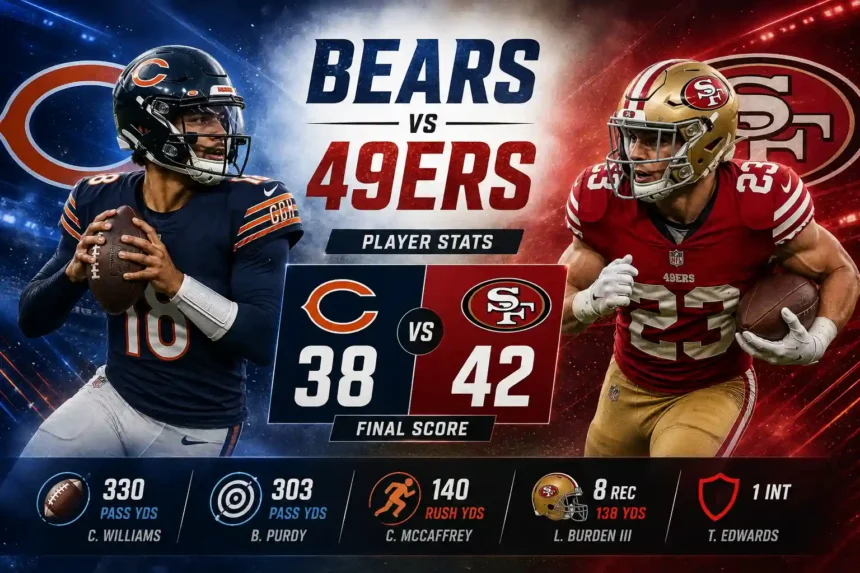
The latest Chicago Bears vs 49ers match player stats come from a dramatic Week 17 game on December 28, 2025. San Francisco defeated Chicago 42–38 at Levi’s Stadium after Brock Purdy produced 303 passing yards and five total touchdowns. Caleb Williams answered with 330 passing yards, two touchdowns, and no turnovers, while Christian McCaffrey led all rushers with 140 yards. The result was not settled until Chicago’s final pass from the San Francisco 2-yard line fell incomplete.
- Chicago Bears vs 49ers Match Player Stats at a Glance
- Quarterback Comparison: Brock Purdy and Caleb Williams
- Brock Purdy recovered from the worst possible start
- Caleb Williams delivered a clean 330-yard performance
- Christian McCaffrey Powered San Francisco’s Rushing Advantage
- D’Andre Swift Made the Most of Limited Carries
- Luther Burden III and Colston Loveland Led Chicago’s Receivers
- San Francisco Spread the Ball Across Eight Receivers
- The Team Stats That Decided the Game
- 1. San Francisco rushed for 90 more yards
- 2. The 49ers were perfect in the red zone
- 3. San Francisco converted 70% of its third downs
- 4. The 49ers answered every major Chicago score
- Scoring Timeline and Game-Changing Moments
- First quarter: An immediate turnover and rapid response
- Second quarter: San Francisco established control
- Second half: Neither offense backed down
- Defensive and Special-Teams Contributions
- Recent Bears–49ers History
- What the Player Stats Reveal
- More Sports Profiles: New York Yankees vs Los Angeles Angels match player stats
- Conclusion
- Frequently Asked Questions
- 1. What was the final score of the latest Bears vs 49ers game?
- 2. Who had the most passing yards?
- 3. How many touchdowns did Brock Purdy score?
- 4. Who led the game in rushing?
- 5. Who was Chicago’s leading receiver?
- 6. Who caught the game-winning touchdown?
- 7. Did Caleb Williams throw an interception?
- 8. Why did the 49ers win despite committing the only turnover?
Chicago Bears vs 49ers Match Player Stats at a Glance
The game featured 80 combined points, 936 total yards, multiple lead changes, and strong performances from both quarterbacks. San Francisco overcame a pick-six on its first offensive play and scored touchdowns on all five of its red-zone visits. Chicago moved the ball effectively but converted only one of three red-zone opportunities into touchdowns.
| Category | Chicago Bears | San Francisco 49ers |
| Final score | 38 | 42 |
| Total yards | 440 | 496 |
| Net passing yards | 330 | 296 |
| Rushing yards | 110 | 200 |
| First downs | 26 | 32 |
| Third-down conversions | 6 of 12 | 7 of 10 |
| Fourth-down conversions | 2 of 2 | 1 of 1 |
| Turnovers | 0 | 1 |
| Red-zone touchdowns | 1 of 3 | 5 of 5 |
| Time of possession | 26:27 | 33:33 |
Statistics from the December 28, 2025, game.
The unusual part of the result was that Chicago won the turnover battle and produced more net passing yards. San Francisco still won because it controlled the ground game, stayed on the field longer, converted third downs efficiently, and finished every red-zone trip with a touchdown.
Quarterback Comparison: Brock Purdy and Caleb Williams
Both quarterbacks produced performances capable of winning an NFL game, but they did so in different ways.
| Quarterback | Comp./Att. | Passing yards | Pass TD | INT | Rushing | Rush TD |
| Caleb Williams | 25/42 | 330 | 2 | 0 | 5 carries, 18 yards | 0 |
| Brock Purdy | 24/33 | 303 | 3 | 1 | 6 carries, 28 yards | 2 |
Brock Purdy recovered from the worst possible start
Purdy’s first pass was intercepted by T.J. Edwards and returned 34 yards for a Chicago touchdown. Instead of allowing the mistake to define the game, Purdy responded with three passing scores and two rushing touchdowns.
His ability to extend plays also mattered. Chicago recorded only one sack and one quarterback hit, giving Purdy enough time to find receivers downfield or escape the pocket. His final touchdown was a 38-yard strike to Jauan Jennings with 2:23 remaining.
Purdy’s five-touchdown contribution was ultimately the most influential individual performance. His interception gave Chicago seven points, but he directly accounted for 30 of San Francisco’s 42 points.
Caleb Williams delivered a clean 330-yard performance
Williams completed 25 of 42 passes for a season-high 330 yards, two touchdowns, no interceptions, and a 100.3 passer rating. He generated explosive plays through the air and took the Bears to San Francisco’s 2-yard line on the final possession.
His two touchdown passes went to rookies Luther Burden III and Colston Loveland. Williams also completed a fourth-and-five pass to Loveland during the final drive, keeping Chicago’s comeback attempt alive.
The principal limitation was red-zone execution rather than overall quarterback production. Chicago reached scoring range repeatedly, but two of its three red-zone possessions ended without touchdowns.
Christian McCaffrey Powered San Francisco’s Rushing Advantage
Christian McCaffrey was the foundation of the 49ers’ balanced offense.
| 49ers rusher | Attempts | Yards | Average | TD |
| Christian McCaffrey | 23 | 140 | 6.1 | 1 |
| Brock Purdy | 6 | 28 | 4.7 | 2 |
| Brian Robinson Jr. | 4 | 22 | 5.5 | 0 |
| Skyy Moore | 1 | 10 | 10.0 | 0 |
McCaffrey added four catches for 41 yards, giving him 181 yards from scrimmage. He also set a 49ers single-season franchise record for receptions by a running back during the game.
San Francisco finished with 200 rushing yards on 34 attempts. That production forced Chicago to respect the run while creating favorable passing situations for Purdy.
McCaffrey’s presence was particularly valuable after San Francisco lost momentum on the opening pick-six. His steady gains allowed the 49ers to avoid becoming one-dimensional.
D’Andre Swift Made the Most of Limited Carries
Chicago did not match San Francisco’s rushing volume, but D’Andre Swift still made a major scoring contribution.
| Bears rusher | Attempts | Yards | Average | TD |
| D’Andre Swift | 9 | 54 | 6.0 | 2 |
| Kyle Monangai | 8 | 38 | 4.8 | 0 |
| Caleb Williams | 5 | 18 | 3.6 | 0 |
Swift scored on runs of 2 and 22 yards. His second touchdown came on the opening play of the fourth quarter and tied the score at 35–35. He also caught two passes for 25 yards.
The issue for Chicago was opportunity. The Bears ran only 22 times, compared with 34 San Francisco rushing attempts. Because the 49ers controlled possession and converted third downs, Chicago had fewer chances to keep using Swift after he established an efficient rhythm.
Luther Burden III and Colston Loveland Led Chicago’s Receivers
Two rookies produced most of Chicago’s passing-game damage.
| Bears receiver | Targets | Receptions | Yards | TD |
| Luther Burden III | 9 | 8 | 138 | 1 |
| Colston Loveland | 10 | 6 | 94 | 1 |
| Jahdae Walker | 4 | 2 | 30 | 0 |
| D’Andre Swift | 3 | 2 | 25 | 0 |
| Cole Kmet | 3 | 2 | 16 | 0 |
Luther Burden III created explosive plays
Burden caught eight of nine targets for 138 yards. His biggest play was a 35-yard touchdown that tied the game at 14 in the first quarter. His combination of volume and efficiency gave Williams a dependable option against San Francisco’s secondary. Burden averaged more than 17 yards per catch and accounted for over 40% of Chicago’s passing yards.
Colston Loveland delivered in serious situations.
Loveland finished with six receptions for 94 yards and a touchdown. His 36-yard scoring catch tied the game at 21 in the second quarter. He later made a 32-yard reception in the fourth quarter and converted a fourth down on Chicago’s final drive.
The production of Burden and Loveland was one of the clearest positives for Chicago. Both generated explosive plays in a high-pressure road game and gave Williams reliable options at different levels of the field.
San Francisco Spread the Ball Across Eight Receivers
The 49ers did not have a 100-yard receiver, but Purdy completed passes to eight players.
| 49ers receiver | Targets | Receptions | Yards | TD |
| Ricky Pearsall | 8 | 5 | 85 | 0 |
| Jake Tonges | 9 | 7 | 60 | 1 |
| Jauan Jennings | 4 | 2 | 42 | 1 |
| Christian McCaffrey | 6 | 4 | 41 | 0 |
| Demarcus Robinson | 2 | 2 | 30 | 0 |
| Kendrick Bourne | 1 | 1 | 25 | 0 |
| Kyle Juszczyk | 2 | 2 | 14 | 1 |
| Brian Robinson Jr. | 1 | 1 | 6 | 0 |
Ricky Pearsall led San Francisco with 85 receiving yards, while Jake Tonges had a team-high seven catches and scored the 49ers’ first touchdown.
Jauan Jennings caught only two passes, but his second reception was the game-winning 38-yard touchdown. Kyle Juszczyk also contributed a 6-yard touchdown in the third quarter.
This distribution made San Francisco difficult to defend. Chicago could not concentrate entirely on McCaffrey or one primary receiver because Purdy consistently found secondary options.
The Team Stats That Decided the Game
The Chicago Bears vs 49ers match player stats show that passing yardage and turnover margin did not determine the winner. Four other categories were more important.
1. San Francisco rushed for 90 more yards
The 49ers gained 200 rushing yards, compared with Chicago’s 110. Their 34 rushing attempts also helped them possess the ball for more than seven additional minutes.
That balance prevented the Bears from attacking Purdy aggressively on every down.
2. The 49ers were perfect in the red zone
San Francisco scored touchdowns on all five red-zone possessions. Chicago scored a touchdown on only one of three red-zone trips.
This was the most decisive efficiency gap. Chicago generated enough yards to win but left potential touchdowns on the field.
3. San Francisco converted 70% of its third downs
The 49ers went 7 of 10 on third down, while the Bears finished 6 of 12. San Francisco also converted its only fourth-down attempt.
Those conversions extended drives and kept Chicago’s defense on the field.
4. The 49ers answered every major Chicago score
Chicago never led by more than seven. Even after the opening defensive touchdown, Purdy responded with a scoring drive. After the Bears tied the game at 35, San Francisco eventually produced the late touchdown that decided the result.
Scoring Timeline and Game-Changing Moments
First quarter: An immediate turnover and rapid response
T.J. Edwards intercepted Purdy’s first pass and returned it 34 yards for a touchdown. Purdy responded with a touchdown pass to Jake Tonges and later ran for a 10-yard score. Williams then found Burden for a 35-yard touchdown, making it 14–14.
Second quarter: San Francisco established control
McCaffrey scored from 5 yards, Loveland answered with a 36-yard touchdown reception, and Purdy’s second rushing score gave the 49ers a 28–21 halftime lead.
One important moment came during San Francisco’s long second-quarter drive. A Purdy interception was erased by a Chicago penalty, and the 49ers eventually scored. The penalty did not count as a turnover, but it represented a major missed opportunity for the Bears.
Second half: Neither offense backed down
Swift’s 2-yard touchdown made it 28–28. Purdy then found Juszczyk for a 6-yard score. Swift opened the fourth quarter with a 22-yard touchdown run to tie the game again. Cairo Santos gave Chicago a 38–35 lead with a 29-yard field goal, but Purdy answered with the touchdown pass to Jennings. Chicago drove to the 2-yard line in the final seconds, but Williams’ last pass to Jahdae Walker was incomplete.
Defensive and Special-Teams Contributions
The most important defensive play belonged to T.J. Edwards. Along with the opening pick-six, he recorded six solo tackles and three assists.
Austin Booker registered Chicago’s only sack. The Bears otherwise struggled to disrupt Purdy, finishing with only one quarterback hit.
San Francisco did not sack Williams or force a turnover. Tatum Bethune led the 49ers with seven solo tackles and four assists, while Dee Winters added seven solo tackles. The defense’s biggest success was situational: it limited Chicago to one red-zone touchdown and made the final stop.
On special teams, Santos converted one field goal and all five extra-point attempts. Eddy Piñeiro did not attempt a field goal but made all six of his extra points.
Recent Bears–49ers History
San Francisco’s 2025 victory moved its all-time series advantage over Chicago to 37–33–1, including a 3–0 postseason record.
The 2025 game was dramatically more competitive than the teams’ previous meeting. On December 8, 2024, the 49ers defeated the Bears 38–13 and outgained them 452–162. One year later, Chicago produced 440 yards, scored 38 points, and reached the 2-yard line with a chance to win.
That contrast illustrates Chicago’s offensive development. Williams and the Bears were no longer simply trying to remain competitive; they matched San Francisco score for score in a playoff-level road environment.
What the Player Stats Reveal
The numbers support five main conclusions:
- Purdy delivered the most complete performance. He recovered from an immediate pick-six and accounted for five touchdowns.
- Williams played well enough to win. His 330 yards, two touchdowns, and zero turnovers were not the reason Chicago lost.
- McCaffrey gave San Francisco offensive balance. His 181 scrimmage yards prevented the Bears from focusing exclusively on Purdy.
- Chicago’s young receiving corps performed under pressure. Burden and Loveland combined for 232 yards and two touchdowns.
- Situational efficiency decided the game. San Francisco’s perfect red-zone performance and 7-of-10 third-down conversion rate outweighed Chicago’s turnover advantage.
More Sports Profiles: New York Yankees vs Los Angeles Angels match player stats
Conclusion
The latest Chicago Bears vs 49ers match player stats describe one of the most entertaining games of the 2025 regular season. Williams and Chicago’s young receivers produced an impressive road performance, but San Francisco was more balanced and more efficient when the field became shorter.
Purdy’s five total touchdowns made him the game’s defining player, while McCaffrey’s 181 scrimmage yards gave the 49ers control and flexibility. Chicago’s 440 total yards and turnover-free offense kept the contest alive until the final play, but its red-zone struggles created a margin the Bears could not fully overcome.
The practical takeaway is clear: Chicago matched San Francisco in explosive passing plays, but the 49ers won through rushing production, third-down execution, and perfect red-zone finishing.
Frequently Asked Questions
1. What was the final score of the latest Bears vs 49ers game?
The San Francisco 49ers defeated the Chicago Bears 42–38 on December 28, 2025, at Levi’s Stadium.
2. Who had the most passing yards?
Caleb Williams led both quarterbacks with 330 passing yards. Brock Purdy finished with 303.
3. How many touchdowns did Brock Purdy score?
Purdy accounted for five touchdowns: three passing and two rushing.
4. Who led the game in rushing?
Christian McCaffrey led all players with 140 rushing yards on 23 attempts. He also scored one rushing touchdown.
5. Who was Chicago’s leading receiver?
Luther Burden III led the Bears with eight receptions for 138 yards and one touchdown.
6. Who caught the game-winning touchdown?
Jauan Jennings caught a 38-yard touchdown pass from Purdy with 2:23 remaining in the fourth quarter.
7. Did Caleb Williams throw an interception?
No. Williams completed 25 of 42 passes for 330 yards, two touchdowns, and no interceptions.
8. Why did the 49ers win despite committing the only turnover?
San Francisco rushed for 200 yards, converted 7 of 10 third downs, controlled possession for 33:33, and scored touchdowns on all five red-zone opportunities. Those advantages outweighed the early interception.