



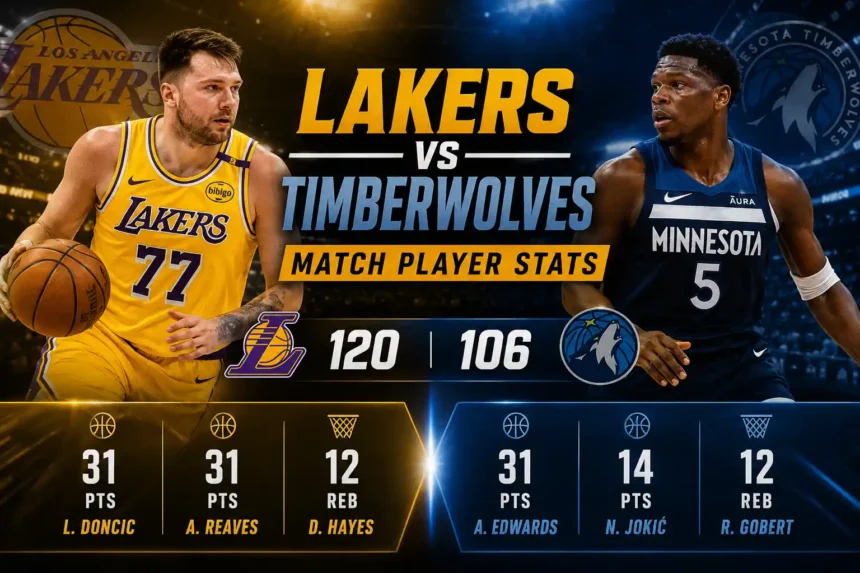
The latest Lakers vs Timberwolves match player stats show that Los Angeles defeated Minnesota 120–106 on March 10, 2026. Luka Dončić produced 31 points, 11 rebounds and 11 assists, while Austin Reaves added 31 points, seven rebounds and eight assists. The Lakers took control with a 39-point third quarter and held Anthony Edwards to 14 points on 2-of-15 shooting. Los Angeles also finished with 31 assists and only seven turnovers, giving it a decisive advantage in ball movement and possession control.
- Lakers vs Timberwolves Match Overview
- Quarter-by-Quarter Score
- Los Angeles Lakers Player Stats
- Minnesota Timberwolves Player Stats
- Luka Dončić Controlled More Than the Scoring Column
- Austin Reaves Produced the Decisive Scoring Burst
- Deandre Ayton Gave Los Angeles an Interior Advantage
- Anthony Edwards Faced a Difficult Defensive Night
- Julius Randle and Minnesota’s Supporting Scorers
- Lakers vs Timberwolves Team Stats Comparison
- How the Third Quarter Changed the Game
- Reaves became more aggressive
- Los Angeles moved the ball faster
- Minnesota failed to punish the defense from outside
- The Lakers controlled costly possessions
- Why the Lakers Won
- 1. Two elite creators
- 2. Better ball security
- 3. Offensive rebounding
- 4. Defensive success against Edwards
- 5. Superior third-quarter execution
- What the Box Score Says About Minnesota
- What the Stats Say About Los Angeles
- Season-Series Significance
- Key Player Performance Takeaways
- More Sports Profiles: San Antonio Spurs vs Atlanta Hawks match player stats
- Conclusion
- Frequently Asked Questions
Lakers vs Timberwolves Match Overview
The Los Angeles Lakers hosted the Minnesota Timberwolves at Crypto.com Arena on March 10, 2026. Both teams entered the night with major Western Conference positioning at stake.
Minnesota started better and held a 21–16 lead after the opening quarter. Los Angeles recovered to tie the game by halftime before dominating the third period 39–23. The Lakers then scored another 36 points in the fourth to close out a 120–106 victory.
| Match detail | Information |
| Date | March 10, 2026 |
| Venue | Crypto.com Arena, Los Angeles |
| Final score | Lakers 120, Timberwolves 106 |
| Halftime score | 45–45 |
| Attendance | 18,997 |
| Lakers’ leading scorers | Luka Dončić and Austin Reaves, 31 each |
| Timberwolves’ leading scorers | Anthony Edwards and Julius Randle, 14 each |
The result brought both teams to 40–25, but Los Angeles gained the season-series tiebreaker after sweeping Minnesota.
Quarter-by-Quarter Score
| Team | First | Second | Third | Fourth | Final |
| Minnesota Timberwolves | 21 | 24 | 23 | 38 | 106 |
| Los Angeles Lakers | 16 | 29 | 39 | 36 | 120 |
The third quarter was the defining period. Los Angeles moved from a tied game to a 16-point lead by combining quicker ball movement, transition pressure and better execution around Dončić and Reaves.
Los Angeles Lakers Player Stats
| Player | MIN | FG | 3PT | FT | REB | AST | STL | BLK | TO | PTS |
| Luka Dončić | 34:56 | 11-24 | 4-12 | 5-6 | 11 | 11 | 2 | 1 | 4 | 31 |
| Austin Reaves | 38:28 | 10-20 | 4-10 | 7-9 | 7 | 8 | 0 | 0 | 1 | 31 |
| Deandre Ayton | 34:08 | 7-11 | 0-0 | 0-2 | 12 | 2 | 1 | 0 | 0 | 14 |
| Luke Kennard | 26:22 | 5-8 | 0-2 | 0-0 | 2 | 2 | 0 | 1 | 0 | 10 |
| Rui Hachimura | 24:29 | 4-8 | 1-4 | 0-0 | 1 | 1 | 0 | 0 | 0 | 9 |
| Marcus Smart | 31:20 | 3-7 | 1-4 | 1-1 | 2 | 1 | 2 | 0 | 0 | 8 |
| Jake LaRavia | 24:47 | 1-7 | 0-2 | 6-8 | 7 | 4 | 2 | 0 | 0 | 8 |
| Jarred Vanderbilt | 14:43 | 2-5 | 0-2 | 0-0 | 4 | 1 | 0 | 0 | 0 | 4 |
| Drew Timme | 2:56 | 1-1 | 1-1 | 0-0 | 0 | 0 | 0 | 0 | 0 | 3 |
| Kobe Bufkin | 1:58 | 1-2 | 0-1 | 0-0 | 0 | 0 | 0 | 0 | 0 | 2 |
| Bronny James | 1:58 | 0-0 | 0-0 | 0-0 | 0 | 1 | 0 | 0 | 0 | 0 |
| Adou Thiero | 1:58 | 0-0 | 0-0 | 0-0 | 1 | 0 | 0 | 0 | 1 | 0 |
| Dalton Knecht | 1:58 | 0-0 | 0-0 | 0-0 | 0 | 0 | 0 | 0 | 0 | 0 |
Statistics are based on the published game box score.
Minnesota Timberwolves Player Stats
| Player | MIN | FG | 3PT | FT | REB | AST | STL | BLK | TO | PTS |
| Anthony Edwards | 30:51 | 2-15 | 1-10 | 9-10 | 2 | 4 | 1 | 1 | 2 | 14 |
| Julius Randle | 26:08 | 5-11 | 1-5 | 3-3 | 7 | 2 | 0 | 0 | 2 | 14 |
| Naz Reid | 25:01 | 6-11 | 1-5 | 0-0 | 6 | 1 | 0 | 2 | 2 | 13 |
| Ayo Dosunmu | 19:30 | 6-8 | 0-2 | 1-2 | 2 | 1 | 0 | 0 | 2 | 13 |
| Terrence Shannon Jr. | 7:31 | 4-6 | 2-2 | 2-2 | 0 | 1 | 0 | 0 | 0 | 12 |
| Bones Hyland | 15:37 | 3-5 | 2-4 | 3-3 | 0 | 3 | 0 | 1 | 0 | 11 |
| Donte DiVincenzo | 31:32 | 3-9 | 2-6 | 0-0 | 5 | 2 | 1 | 0 | 1 | 8 |
| Jaden McDaniels | 26:29 | 3-9 | 0-5 | 0-0 | 2 | 0 | 1 | 0 | 2 | 6 |
| Kyle Anderson | 14:32 | 2-2 | 0-0 | 1-2 | 6 | 3 | 0 | 1 | 0 | 5 |
| Jaylen Clark | 3:55 | 2-2 | 1-1 | 0-0 | 0 | 0 | 0 | 0 | 0 | 5 |
| Rudy Gobert | 27:09 | 0-1 | 0-0 | 3-6 | 12 | 2 | 0 | 0 | 0 | 3 |
| Julian Phillips | 3:55 | 1-1 | 0-0 | 0-0 | 1 | 1 | 1 | 0 | 0 | 2 |
| Joe Ingles | 3:55 | 0-0 | 0-0 | 0-0 | 0 | 1 | 0 | 0 | 0 | 0 |
| Joan Beringer | 3:55 | 0-0 | 0-0 | 0-0 | 0 | 1 | 0 | 0 | 0 | 0 |
Minnesota received useful bench scoring, but its starting unit did not generate enough efficient offense to match the Lakers after halftime.
Luka Dončić Controlled More Than the Scoring Column
Dončić’s 31 points were only one part of his influence. He also collected 11 rebounds and delivered 11 assists, completing his seventh triple-double of the season.
His stat line showed how thoroughly he managed the offense:
- 31 points
- 11 rebounds
- 11 assists
- Two steals
- One block
- Four made three-pointers
- Plus-20 point differential
Even during an inefficient opening stretch, Dončić continued creating passing angles and forcing Minnesota to commit extra defenders. Once the Lakers began converting more of those opportunities, the game changed quickly.
His rebounding was also significant. By securing defensive boards himself, Dončić could immediately begin possessions without waiting for an outlet pass. That allowed Los Angeles to attack before Minnesota fully organized its defense.
The triple-double therefore reflected control of the game rather than empty accumulation. He scored, initiated offense and helped finish defensive possessions.
Austin Reaves Produced the Decisive Scoring Burst
Reaves matched Dončić with 31 points, but the timing of his production made the performance especially valuable.
He scored 29 of his 31 points after halftime and became the main offensive force during the Lakers’ third-quarter takeover. His complete line included:
- 31 points
- Eight assists
- Seven rebounds
- 10-of-20 field-goal shooting
- Four made three-pointers
- Seven made free throws
- Only one turnover
That last number mattered. Reaves combined high usage with careful decision-making, giving Los Angeles another dependable ball handler alongside Dončić.
Minnesota could not simply load its defense toward one creator. When the Timberwolves sent help toward Dončić, Reaves attacked the resulting space. When they stayed closer to Reaves, Dončić controlled the primary action.
Reaves also created two four-point plays during his second-half surge, helping Los Angeles convert a close contest into a comfortable lead.
Deandre Ayton Gave Los Angeles an Interior Advantage
Deandre Ayton finished with 14 points and 12 rebounds while shooting 7-of-11 from the field.
Five of his rebounds came on the offensive glass. Those extra possessions were valuable because neither team shot particularly well from three-point range.
Ayton’s activity around the basket gave the Lakers:
- A reliable interior finisher
- Second-chance opportunities
- A defensive rebounder against Minnesota’s size
- A target for Dončić and Reaves in the pick-and-roll
- Efficient scoring without requiring many touches
Rudy Gobert also collected 12 rebounds, but Minnesota received only three points from him. Ayton’s ability to combine similar rebounding production with 14 points gave Los Angeles the more productive center performance.
Anthony Edwards Faced a Difficult Defensive Night
Anthony Edwards entered the matchup as Minnesota’s most dangerous scorer, but the Lakers held him to one of his least efficient performances.
Edwards recorded:
- 14 points
- 2-of-15 field-goal shooting
- 1-of-10 three-point shooting
- Four assists
- Two rebounds
- Two turnovers
Nine of his 14 points came at the free-throw line. From live play, Los Angeles prevented him from finding a consistent rhythm.
Marcus Smart played an important role by applying physical on-ball pressure and making Edwards work before reaching his preferred scoring areas. The Lakers also showed help defenders early enough to discourage direct drives without completely abandoning Minnesota’s other shooters.
Edwards was still able to draw fouls, but his inability to convert jump shots reduced Minnesota’s offensive ceiling. When its primary scorer struggles, the Timberwolves need strong creation from Randle, DiVincenzo and the bench. That support arrived in stretches, but not consistently enough to match the Lakers’ star duo.
Julius Randle and Minnesota’s Supporting Scorers
Julius Randle tied Edwards for the team lead with 14 points. He shot 5-of-11 and collected seven rebounds, but he attempted only 11 field goals in 26 minutes.
Naz Reid and Ayo Dosunmu each added 13 points. Bones Hyland scored 11 in fewer than 16 minutes, while Terrence Shannon Jr. produced 12 points in a short fourth-quarter appearance.
Minnesota’s bench outscored the Lakers’ reserves by a large margin, but much of that production came after Los Angeles had already established control. The Lakers’ main rotation created the decisive separation.
The Timberwolves needed more from their starters:
- Edwards and Randle combined for 28 points.
- Dončić and Reaves combined for 62.
- Minnesota’s five starters totaled only 45 points.
- Los Angeles’ five starters produced 93.
That 48-point difference between the starting units was more important than Minnesota’s advantage in bench scoring.
Lakers vs Timberwolves Team Stats Comparison
| Category | Timberwolves | Lakers |
| Field goals | 37-80 | 45-93 |
| Field-goal percentage | 46.3% | 48.4% |
| Three-pointers | 10-40 | 11-38 |
| Three-point percentage | 25.0% | 28.9% |
| Free throws | 22-28 | 19-26 |
| Total rebounds | 52 | 52 |
| Offensive rebounds | 8 | 14 |
| Assists | 22 | 31 |
| Steals | 4 | 7 |
| Blocks | 5 | 2 |
| Turnovers | 11 | 7 |
| Points | 106 | 120 |
Both teams struggled from behind the arc, so the game was not decided by outstanding three-point shooting. Los Angeles separated itself through possession quality.
The Lakers recorded nine more assists, six additional offensive rebounds and four fewer turnovers. Those differences created more scoring opportunities even though the shooting percentages were relatively close.
How the Third Quarter Changed the Game
The teams were tied 45–45 at halftime. Los Angeles then scored 39 points in the third quarter while holding Minnesota to 23.
Several changes drove that turnaround.
Reaves became more aggressive
Reaves attacked sooner in possessions instead of waiting for the defense to settle. His scoring forced Minnesota to reconsider how much attention it could devote to Dončić.
Los Angeles moved the ball faster
The Lakers finished with 31 assists on 45 made field goals. More than two-thirds of their baskets were assisted, reflecting a connected offensive performance.
Minnesota failed to punish the defense from outside
The Timberwolves made only 10 of 40 three-point attempts. Edwards and McDaniels combined to shoot 1-of-15 from deep, allowing Los Angeles to help more aggressively around the ball.
The Lakers controlled costly possessions
Minnesota committed 11 turnovers, which Los Angeles converted into 20 points. The Lakers also scored 56 points in the paint, compared with 42 for the Timberwolves.
Why the Lakers Won
The Lakers’ victory can be explained through five statistical advantages.
1. Two elite creators
Dončić and Reaves combined for 62 points, 19 assists and 18 rebounds. Minnesota did not have a comparable pair of performers.
2. Better ball security
Los Angeles committed only seven turnovers. That was especially impressive because Dončić and Reaves handled most of the offense.
3. Offensive rebounding
The Lakers collected 14 offensive boards. Ayton had five, while LaRavia added another five.
4. Defensive success against Edwards
Holding Minnesota’s leading scorer to two made field goals changed the structure of the game. The Timberwolves had to rely on less consistent creators.
5. Superior third-quarter execution
The 39–23 third period gave Los Angeles enough separation to withstand Minnesota’s 38-point fourth quarter.
What the Box Score Says About Minnesota
The Lakers vs Timberwolves match player stats reveal that Minnesota’s final total was not disastrous, but the offense lacked dependable star production.
The Timberwolves shot 46.3% overall and reached 106 points. However, their 25% three-point shooting and limited starting-unit production made sustained runs difficult.
Minnesota also had an unusual scoring distribution. Six bench players reached at least five points, yet only two starters reached double figures.
That can be useful over a long season, but in a major matchup, teams generally need their highest-usage players to control the most important stretches. Edwards and Randle were outscored by Dončić alone, 31–28.
What the Stats Say About Los Angeles
Los Angeles demonstrated that it could win a high-level matchup without relying on LeBron James, who missed the game through injury.
Dončić handled the central creation role, while Reaves provided secondary scoring and playmaking. Ayton controlled the interior, and Smart contributed defensive pressure that was not fully represented by his eight points.
The Lakers did not need an exceptional three-point night. They won while shooting below 29% from deep because they:
- Created more assisted baskets
- Protected possession
- Generated offensive rebounds
- Scored in the paint
- Received efficient production from Ayton
- Neutralized Minnesota’s primary scorer
That profile is encouraging because it shows more than one route to victory.
Season-Series Significance
The victory completed a season sweep for Los Angeles. All three wins reportedly came without LeBron James, making the result even more notable.
The Lakers and Timberwolves ended the night with matching 40–25 records, but the sweep gave Los Angeles the head-to-head tiebreaker and moved it into fourth place in the Western Conference standings at that point in the season.
Key Player Performance Takeaways
| Player | Main takeaway |
| Luka Dončić | Controlled scoring, rebounding and playmaking with a triple-double |
| Austin Reaves | Delivered the decisive second-half scoring surge |
| Deandre Ayton | Added efficient interior scoring and 12 rebounds |
| Marcus Smart | Helped disrupt Anthony Edwards and avoided turnovers |
| Jake LaRavia | Shot poorly but added seven rebounds, four assists and two steals |
| Anthony Edwards | Drew fouls but struggled badly from the field |
| Julius Randle | Scored efficiently enough but lacked offensive volume |
| Naz Reid | Provided Minnesota’s most dependable bench production |
| Rudy Gobert | Rebounded well but contributed little as a scorer |
More Sports Profiles: San Antonio Spurs vs Atlanta Hawks match player stats
Conclusion
The latest Lakers vs Timberwolves match player stats tell a clear story. Los Angeles won because its leading players controlled the most important parts of the game. Dončić supplied a 31-point triple-double, Reaves delivered 31 points with only one turnover, and Ayton added an efficient double-double. On the other side, Minnesota received useful bench production but could not overcome Edwards’ 2-of-15 shooting performance or the 62 combined points generated by the Lakers’ starting backcourt. The final score was shaped less by three-point accuracy and more by possession management. Los Angeles passed the ball better, secured more offensive rebounds, committed fewer turnovers and dominated the third quarter. Those advantages transformed an even first half into a convincing 120–106 victory.
Frequently Asked Questions
Who won the Lakers vs Timberwolves game?
The Los Angeles Lakers defeated the Minnesota Timberwolves 120–106 on March 10, 2026, at Crypto.com Arena.
Who scored the most points in the game?
Luka Dončić and Austin Reaves tied for the game-high with 31 points each. Together, they produced 62 of the Lakers’ 120 points.
Did Luka Dončić record a triple-double?
Yes. Dončić finished with 31 points, 11 rebounds and 11 assists. It was his seventh triple-double of the season.
How many points did Austin Reaves score?
Reaves scored 31 points on 10-of-20 shooting. He also contributed eight assists, seven rebounds and four three-pointers.
How did Anthony Edwards perform?
Edwards scored 14 points but made only two of his 15 field-goal attempts. He shot 1-of-10 from three-point range and made nine of 10 free throws.
Who had the most rebounds?
Deandre Ayton and Rudy Gobert each recorded 12 rebounds. Dončić followed with 11 rebounds.
Which team had more assists?
The Lakers finished with 31 assists, while the Timberwolves had 22. Dončić led all players with 11.
What was the main turning point?
The third quarter decided the contest. Los Angeles outscored Minnesota 39–23, turning a 45–45 halftime tie into a 16-point advantage.