




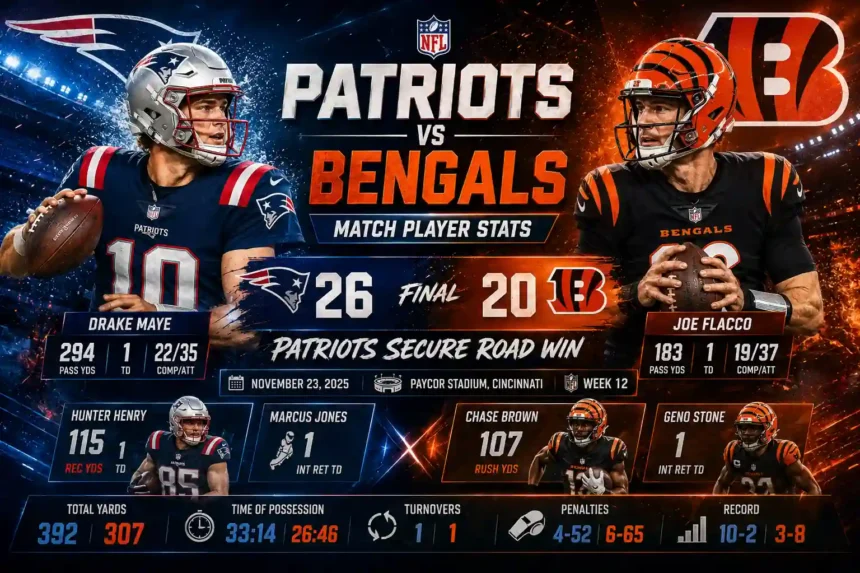
The latest New England Patriots vs Bengals match player stats come from New England’s 26–20 road victory over Cincinnati on November 23, 2025. Drake Maye passed for 294 yards, Hunter Henry produced 115 receiving yards and a touchdown, and Marcus Jones returned an interception for a score. Cincinnati received 107 rushing yards from Chase Brown, but Joe Flacco finished with only 183 passing yards as the Bengals’ final comeback attempt ended at New England’s 26-yard line.
- Patriots vs. Bengals Final Score and Game Snapshot
- New England Patriots Player Stats
- Cincinnati Bengals Player Stats
- Quarter-by-Quarter Scoring Timeline
- Five Statistics That Decided the Game
- 1. Drake Maye’s 294 passing yards
- 2. Hunter Henry’s 115 receiving yards
- 3. The exchange of defensive touchdowns
- 4. Andy Borregales’ four field goals
- 5. New England’s advantage in yardage and possession
- Most Influential Patriots Performers
- What Cincinnati Did Well
- Why the Bengals Still Fell Short
- Patriots vs. Bengals: 2024 and 2025 Matchup Comparison
- What the Result Revealed About Both Teams
- More Sports Profiles: Houston Astros vs New York Yankees match player stats
- Conclusion
- Frequently Asked Questions
- Who won the Patriots versus Bengals game in 2025?
- What were Drake Maye’s stats against Cincinnati?
- Who had the most receiving yards?
- Who was the leading rusher?
- Did Joe Burrow play against the Patriots?
- How many turnovers occurred?
- Why was Marcus Jones’ interception so important?
- What was the biggest difference between the 2024 and 2025 games?
The game was much closer than the teams’ records suggested. Cincinnati built a 10–0 advantage with help from a Geno Stone pick-six, but New England answered with 17 consecutive second-quarter points. The Patriots then relied on defense, possession control, Hunter Henry’s receiving production, and four Andy Borregales field goals to protect the lead.
Patriots vs. Bengals Final Score and Game Snapshot
| Game detail | Result |
| Final score | Patriots 26, Bengals 20 |
| Date | November 23, 2025 |
| Week | NFL Week 12 |
| Venue | Paycor Stadium, Cincinnati |
| Patriots record after game | 10–2 |
| Bengals record after game | 3–8 |
| New England total yards | 392 |
| Cincinnati total yards | 307 |
| Time of possession | Patriots 33:14, Bengals 26:46 |
| Turnovers | One by each team |
New England outgained Cincinnati by 85 yards and held the ball for more than six additional minutes. The Patriots also committed fewer penalties, finishing with four for 52 yards compared with six penalties for 65 yards by the Bengals. Those advantages helped New England survive its red-zone failures and an early interception returned for a touchdown.
The final score does not fully show how frequently the momentum shifted. Both defenses scored touchdowns, both kickers made attempts from beyond 50 yards, and Cincinnati had possession with an opportunity to win in the final minute.
New England Patriots Player Stats
Patriots passing
| Player | Completions/Attempts | Passing yards | Touchdowns | Interceptions |
| Drake Maye | 22/35 | 294 | 1 | 1 |
Maye’s performance included both the Patriots’ most damaging mistake and several of their most important offensive plays. His early interception was returned 32 yards for a Cincinnati touchdown, but he responded on the next possession by finding Hunter Henry for a 28-yard score. At the time, Maye’s 294 passing yards represented a new career high.
He also completed a 37-yard throw to DeMario Douglas and continued moving the ball after injuries disrupted the left side of New England’s offensive line. Maye was not flawless, particularly when Cincinnati sent extra pressure, but his ability to recover after the pick-six prevented the game from getting away from the Patriots.
Patriots rushing
| Player | Carries | Rushing yards | Longest run | Touchdowns |
| TreVeyon Henderson | 18 | 66 | 9 | 0 |
| Drake Maye | 5 | 22 | 12 | 0 |
| DeMario Douglas | 1 | 14 | 14 | 0 |
| Rhamondre Stevenson | 6 | 5 | 3 | 0 |
| Terrell Jennings | 1 | 0 | 0 | 0 |
TreVeyon Henderson handled the largest workload, but Cincinnati kept New England from producing a major rushing play. Henderson’s longest run gained nine yards, while Stevenson managed five yards on six attempts. The Patriots compensated with Maye’s mobility and a 14-yard carry by Douglas.
The limited rushing production became especially noticeable near the goal line. New England ran six plays from Cincinnati’s 1-yard line during one third-quarter sequence and still came away without points. That failure helped the Bengals remain within one possession late in the game.
Patriots receiving
| Player | Receptions | Receiving yards | Longest catch | Touchdowns |
| Hunter Henry | 7 | 115 | 28 | 1 |
| Austin Hooper | 3 | 39 | 21 | 0 |
| DeMario Douglas | 1 | 37 | 37 | 0 |
| Mack Hollins | 2 | 30 | 24 | 0 |
| Stefon Diggs | 2 | 20 | 14 | 0 |
| Kyle Williams | 1 | 18 | 18 | 0 |
| TreVeyon Henderson | 3 | 15 | 7 | 0 |
| Kayshon Boutte | 2 | 15 | 9 | 0 |
| Rhamondre Stevenson | 1 | 5 | 5 | 0 |
Henry delivered the best offensive performance of the game. He caught seven passes for a career-high 115 yards and scored New England’s only offensive touchdown. His 28-yard score immediately followed Cincinnati’s pick-six and restored stability to an offense that had started poorly.
New England’s two leading tight ends combined for 10 receptions and 154 yards. Henry attacked openings behind Cincinnati’s linebackers, while Hooper contributed three catches for 39 yards. This production gave Maye a reliable answer when the wide receivers were not consistently separating downfield.
Douglas caught only one pass, but it gained 37 yards and was one of the most difficult completions of the afternoon. Hollins, Diggs, Williams and Boutte each provided smaller contributions that helped New England sustain drives and create field-goal opportunities.
Cincinnati Bengals Player Stats
Bengals passing
| Player | Completions/Attempts | Passing yards | Touchdowns | Interceptions |
| Joe Flacco | 19/37 | 183 | 1 | 1 |
| Jake Browning | 1/1 | 14 | 0 | 0 |
Flacco struggled to create consistent downfield production. His 37 attempts generated 183 passing yards, and his interception to Marcus Jones was returned for a 33-yard touchdown. That defensive score gave New England its first lead after the Patriots had trailed 10–0.
Flacco did produce Cincinnati’s best offensive moment late in the fourth quarter. He completed a 17-yard touchdown pass to Mitchell Tinsley with 4:40 remaining, reducing New England’s advantage to 23–20. He then moved the Bengals to the Patriots’ 26-yard line on their final possession before an incomplete fourth-down pass ended the game.
Cincinnati played without Joe Burrow, while Ja’Marr Chase was unavailable because of a one-game suspension. Tee Higgins was therefore the primary established receiver, but New England limited him to 31 yards before he left late in the game with a concussion.
Bengals rushing
| Player | Carries | Rushing yards | Longest run | Touchdowns |
| Chase Brown | 19 | 107 | 21 | 0 |
| Tahj Brooks | 2 | 5 | 3 | 0 |
| Andrei Iosivas | 1 | 5 | 5 | 0 |
| Joe Flacco | 1 | 3 | 3 | 0 |
Brown was Cincinnati’s most effective offensive player. He averaged strong gains, registered the game’s only 100-yard rushing performance and became the first running back to surpass 100 yards against the Patriots during the 2025 season.
His production showed that Cincinnati could move the ball without depending entirely on its depleted passing attack. However, the Bengals did not turn that rushing success into a touchdown. Cincinnati’s only offensive touchdown came through the air, while the other touchdown was scored by the defense.
Bengals receiving
| Player | Receptions | Receiving yards | Longest catch | Touchdowns |
| Andrei Iosivas | 4 | 61 | 19 | 0 |
| Mike Gesicki | 4 | 35 | 13 | 0 |
| Tee Higgins | 5 | 31 | 16 | 0 |
| Mitchell Tinsley | 2 | 29 | 17 | 1 |
| Chase Brown | 2 | 23 | 17 | 0 |
| Noah Fant | 1 | 9 | 9 | 0 |
| Tanner Hudson | 1 | 9 | 9 | 0 |
| Drew Sample | 1 | 0 | 0 | 0 |
Iosivas led Cincinnati with 61 receiving yards, despite catching one fewer pass than Higgins. Tinsley made the most valuable reception, scoring the late 17-yard touchdown that gave the Bengals a final opportunity to complete the comeback.
New England’s coverage concentrated heavily on Higgins. Christian Gonzalez followed him on most of his routes and helped prevent Cincinnati’s most established available receiver from taking control of the game. Higgins finished with five receptions, but his 31 yards reflected how effectively the Patriots limited yards after the catch and deeper completions.
Quarter-by-Quarter Scoring Timeline
| Quarter | Scoring play | Score after play |
| First | Evan McPherson 54-yard field goal | Bengals 3–0 |
| Second | Geno Stone 32-yard interception return | Bengals 10–0 |
| Second | Hunter Henry 28-yard TD catch | Bengals 10–7 |
| Second | Marcus Jones 33-yard interception return | Patriots 14–10 |
| Second | Andy Borregales 41-yard field goal | Patriots 17–10 |
| Second | Evan McPherson 63-yard field goal | Patriots 17–13 |
| Third | Borregales 45-yard field goal | Patriots 20–13 |
| Fourth | Borregales 19-yard field goal | Patriots 23–13 |
| Fourth | Mitchell Tinsley 17-yard TD catch | Patriots 23–20 |
| Fourth | Borregales 52-yard field goal | Patriots 26–20 |
Cincinnati controlled the opening stages. McPherson’s 54-yard kick produced the first points, and Stone’s interception return gave the Bengals a double-digit lead only 41 seconds into the second quarter.
New England’s response changed the game. Maye led a nine-play, 70-yard touchdown drive, finishing it with his pass to Henry. Marcus Jones then read Flacco’s attempted checkdown, jumped the route and returned the interception for a touchdown. The Patriots scored two touchdowns in less than two minutes and transformed a 10–0 deficit into a 14–10 lead.
McPherson’s 63-yard field goal at the end of the first half kept Cincinnati close. It was a Bengals franchise record, but New England maintained control through three Borregales field goals in the second half.
Five Statistics That Decided the Game
1. Drake Maye’s 294 passing yards
The quarterbacks both threw one touchdown and one interception, but Maye generated 111 more passing yards than Flacco. That difference allowed New England to overcome its weak rushing output and repeatedly move into scoring range.
Maye’s performance was particularly valuable because New England lost left guard Jared Wilson and left tackle Will Campbell during the game. He continued producing through the air behind a reorganized offensive line and avoided another turnover after his early interception.
2. Hunter Henry’s 115 receiving yards
No other player reached 70 receiving yards. Henry did more than lead the game statistically; he provided the touchdown New England needed immediately after falling behind by 10 points.
His ability to work between Cincinnati’s coverage levels created efficient opportunities for Maye. Henry and Hooper also gave New England a productive two-tight-end passing structure when the outside receivers were not dominating.
3. The exchange of defensive touchdowns
Stone’s pick-six initially gave Cincinnati complete control, but Jones answered with a pick-six of his own. Because both teams scored seven defensive points, neither gained a lasting turnover advantage.
Jones’ interception was more influential in terms of momentum because it completed New England’s rapid comeback and gave the Patriots a lead they never surrendered.
4. Andy Borregales’ four field goals
New England scored only one offensive touchdown, making Borregales essential. He converted attempts from 41, 45, 19 and 52 yards.
His final kick came with 1:51 remaining and expanded the lead from three points to six. That forced Cincinnati to pursue a touchdown on its last drive rather than move into position for a tying field goal.
5. New England’s advantage in yardage and possession
The Patriots accumulated 392 total yards compared with Cincinnati’s 307. They also possessed the ball for 33:14, limiting the amount of time Cincinnati’s short-handed offense had to work.
New England did not convert every promising drive into a touchdown, but its ability to maintain possession consistently created manageable field-goal attempts. Cincinnati, by contrast, needed a late 71-yard touchdown drive just to reduce the deficit to three points.
Most Influential Patriots Performers
Hunter Henry
Henry was New England’s most consistent offensive weapon. His seven catches, 115 yards and touchdown made him the clear statistical standout.
He was especially effective on crossing routes and against openings in Cincinnati’s zone coverage. His touchdown came on a layered route concept that created open space near the sideline, allowing Maye to make a relatively clean throw for New England’s only offensive touchdown.
Drake Maye
Maye’s interception prevented him from producing a mistake-free performance, but his response mattered more than the error. He set a career high in passing yards, led the immediate touchdown drive and continued generating explosive completions after the offensive-line injuries.
Marcus Jones
Jones made the game’s defining defensive play. His 33-yard interception return erased Cincinnati’s advantage and represented New England’s first pick-six since the 2023 season. He also remained involved as the Patriots stopped Cincinnati’s final drive.
Andy Borregales
Borregales converted every field-goal opportunity and accounted for 12 points. With the offense failing to finish multiple possessions in the end zone, his accuracy became the difference between controlling the second half and leaving Cincinnati with a chance to take the lead using only a field goal.
What Cincinnati Did Well
The Bengals successfully pressured Maye into an early mistake. Stone read the quarterback’s attempt to fit the ball toward Henry and turned the interception into a touchdown.
Cincinnati also ran effectively. Brown’s 107 yards exposed a weakening area of New England’s defense and gave the Bengals a more balanced approach than the final passing statistics suggest.
McPherson delivered two exceptional kicks from 54 and 63 yards. His second field goal prevented New England from taking a seven-point lead into halftime and kept the Bengals within one possession for much of the second half.
Cincinnati’s defense also stopped New England near the goal line. Those stops mattered because the Patriots reached scoring territory frequently enough to build a much larger advantage.
Why the Bengals Still Fell Short
The biggest problem was the passing game’s lack of sustained production. Cincinnati’s quarterbacks combined for 197 passing yards, and Flacco completed fewer passes on more attempts than Maye.
The absence of Burrow and Chase reduced the Bengals’ ability to attack New England downfield. Higgins drew focused coverage and was limited to 31 yards, while Cincinnati did not have another receiver capable of consistently forcing the Patriots to change their defensive plan.
The Bengals also failed to convert Brown’s rushing success into touchdowns. A 100-yard rushing performance usually creates favorable play-action opportunities, but Cincinnati scored only one offensive touchdown.
Finally, the defense could not force a stop after Tinsley’s fourth-quarter touchdown. New England answered with a nine-play possession and Borregales’ 52-yard field goal, leaving Cincinnati in a touchdown-or-lose situation.
Patriots vs. Bengals: 2024 and 2025 Matchup Comparison
The keyword can also produce information about the teams’ September 8, 2024 meeting. New England won both games, but the player leaders and offensive approaches were significantly different.
| Category | 2024 matchup | 2025 matchup |
| Final score | Patriots 16, Bengals 10 | Patriots 26, Bengals 20 |
| Patriots quarterback | Jacoby Brissett | Drake Maye |
| Patriots passing yards | 121 | 294 |
| Leading Patriots rusher | Rhamondre Stevenson, 120 yards | TreVeyon Henderson, 66 yards |
| Bengals quarterback | Joe Burrow | Joe Flacco |
| Bengals passing yards | 164 | 183 |
| Leading Bengals receiver | Ja’Marr Chase, 62 yards | Andrei Iosivas, 61 yards |
| Main difference | Ground control and defense | Passing, defensive score and kicking |
In 2024, Stevenson carried 25 times for 120 yards and scored New England’s only touchdown. Brissett attempted only 24 passes, while the Patriots controlled possession and won a low-scoring opener.
The 2025 meeting contained more passing production, two defensive touchdowns and five field goals of at least 41 yards. Maye replaced Brissett as the central figure in New England’s offense, while Flacco started for Cincinnati instead of Burrow.
What the Result Revealed About Both Teams
For New England, the victory demonstrated resilience. The Patriots survived a pick-six, offensive-line injuries, weak goal-line execution and a productive performance by Cincinnati’s running game. They still produced 392 yards and protected the lead in the closing seconds.
The result also exposed areas that required improvement. New England’s goal-line offense left points on the field, while its defense allowed its first 100-yard rusher of the season. Those weaknesses did not cause a loss against Cincinnati, but they represented potential problems against stronger opponents.
For the Bengals, the match reflected a recurring inability to finish close games. Cincinnati generated major contributions from Brown, Stone and McPherson, but the offense remained too limited without Burrow and Chase.
Retrospectively, the result fit the teams’ broader 2025 trajectories. New England completed the regular season 14–3 and won the AFC East, while Cincinnati finished 6–11 and third in the AFC North.
More Sports Profiles: Houston Astros vs New York Yankees match player stats
Conclusion
The player statistics show that New England won by producing more through the passing game and responding better to adversity. Maye recovered from an early pick-six, Henry delivered the game’s best receiving performance, Jones supplied a momentum-changing defensive touchdown, and Borregales converted every field-goal opportunity. Cincinnati received an excellent rushing effort from Brown and important plays from Stone and McPherson. However, its limited passing attack, failure to turn rushing success into touchdowns and inability to stop New England’s final scoring drive prevented the comeback.
The 26–20 score suggests a narrow contest, but the deeper numbers explain New England’s advantage: 392 total yards, longer possession, superior quarterback production and more reliable execution in the game’s decisive moments.
Frequently Asked Questions
Who won the Patriots versus Bengals game in 2025?
The New England Patriots defeated the Cincinnati Bengals 26–20 on November 23, 2025, at Paycor Stadium. The victory improved New England’s record to 10–2.
What were Drake Maye’s stats against Cincinnati?
Maye completed 22 of 35 passes for 294 yards, one touchdown and one interception. He also rushed five times for 22 yards.
Who had the most receiving yards?
Hunter Henry led all players with seven receptions for 115 yards. He also caught a 28-yard touchdown pass from Maye.
Who was the leading rusher?
Chase Brown led the game with 107 rushing yards on 19 carries. TreVeyon Henderson led New England with 66 yards on 18 attempts.
Did Joe Burrow play against the Patriots?
No. Joe Flacco started for Cincinnati and completed 19 of 37 passes for 183 yards, one touchdown and one interception. Burrow had been recovering from injury.
How many turnovers occurred?
Each quarterback threw one interception, and both interceptions were returned for touchdowns. Geno Stone scored for Cincinnati, while Marcus Jones scored for New England.
Why was Marcus Jones’ interception so important?
Jones’ 33-yard return gave New England a 14–10 lead shortly after the Patriots had trailed 10–0. It completed a rapid momentum shift and gave New England a lead it retained for the rest of the game.
What was the biggest difference between the 2024 and 2025 games?
The 2024 game was driven by Stevenson’s 120 rushing yards and New England’s ball-control approach. The 2025 game featured Maye’s 294 passing yards, Henry’s 115 receiving yards, two defensive touchdowns and four field goals from Borregales.