



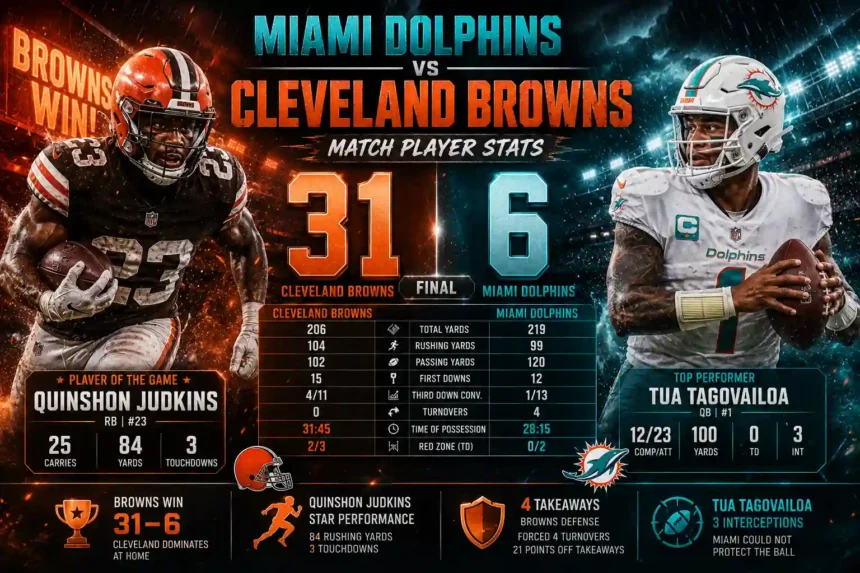
Cleveland defeated Miami 31–6 in the latest meeting between the teams on October 19, 2025. Quinshon Judkins led the Browns with 84 rushing yards and three touchdowns, while Dillon Gabriel completed 13 of 18 passes for 116 yards without a turnover. De’Von Achane gained 82 yards on 13 carries for Miami, but Tua Tagovailoa completed only 12 of 23 passes for 100 yards and threw three interceptions. Cleveland forced four turnovers and produced 21 points from those takeaways.
- Game Overview and Final Score
- Miami Dolphins vs Cleveland Browns Match Player Stats at a Glance
- How Cleveland Won Despite Being Outgained
- Four takeaways changed the field
- Third down ended Miami’s possessions
- Red-zone results separated the teams
- Quarter-by-Quarter Game Breakdown
- First quarter: Cleveland takes an early lead
- Second quarter: Both running backs break free
- Third quarter: Campbell delivers the knockout play
- Fourth quarter: Cleveland converts another short field
- Tua Tagovailoa vs Dillon Gabriel
- Quinshon Judkins vs De’Von Achane
- Receiving Stats and Passing-Game Limitations
- Defensive Players Who Decided the Game
- Special Teams, Penalties and Hidden Yardage
- What the Player Stats Really Reveal
- How the Result Reversed the Previous Meeting
- Top Five Performers
- Conclusion
- FAQs
- 1. Who won the latest Miami Dolphins vs Cleveland Browns game?
- 2. What were the key Miami Dolphins vs Cleveland Browns match player stats?
- 3. How many touchdowns did Quinshon Judkins score?
- 4. How many interceptions did Tua Tagovailoa throw?
- 5. Who led the Dolphins in rushing?
- 6. Who led the game in receiving yards?
- 7. How did Cleveland win with fewer total yards?
- 8. What was the score of the previous Dolphins–Browns matchup?
Game Overview and Final Score
The Week 7 matchup was played at Huntington Bank Field in Cleveland in steady rain. The Browns scored in every quarter, while all six of Miami’s points came from two second-quarter field goals.
| Game detail | Result |
| Date | October 19, 2025 |
| Venue | Huntington Bank Field, Cleveland |
| Final score | Browns 31, Dolphins 6 |
| Halftime score | Browns 17, Dolphins 6 |
| Miami record after game | 1–6 |
| Cleveland record after game | 2–5 |
| Leading scorer | Quinshon Judkins, 3 touchdowns |
| Decisive factor | Four Cleveland takeaways |
Cleveland never needed a high-volume passing performance. Instead, the Browns combined a controlled rushing plan with short fields, defensive takeaways and disciplined situational football. Miami moved the ball effectively on a few possessions but failed to turn those opportunities into touchdowns.
Miami Dolphins vs Cleveland Browns Match Player Stats at a Glance
The team totals reveal one of the most interesting facts about the contest: Miami gained more yards but lost by 25 points.
| Team statistic | Miami Dolphins | Cleveland Browns |
| Total first downs | 12 | 15 |
| Third-down conversions | 1 of 13 | 4 of 11 |
| Fourth-down conversions | 2 of 4 | 0 of 0 |
| Total net yards | 219 | 206 |
| Net rushing yards | 99 | 104 |
| Net passing yards | 120 | 102 |
| Offensive plays | 57 | 53 |
| Turnovers | 4 | 0 |
| Penalties | 11 for 103 yards | 5 for 37 yards |
| Red-zone efficiency | 0 of 2 | 2 of 3 |
| Time of possession | 28:15 | 31:45 |
Miami averaged 4.5 yards per rushing attempt, compared with Cleveland’s 3.2, and finished with 13 more total yards. Those advantages did not matter because the Dolphins lost possession four times, converted only one third down and failed to score a touchdown on two red-zone visits.
Passing leaders
| Player | Completions/Attempts | Yards | TD | INT | Passer rating |
| Dillon Gabriel, CLE | 13/18 | 116 | 0 | 0 | 89.1 |
| Tua Tagovailoa, MIA | 12/23 | 100 | 0 | 3 | 24.1 |
| Quinn Ewers, MIA | 5/8 | 53 | 0 | 0 | 81.8 |
The individual passing totals are gross yardage. After sacks are included, Miami finished with 120 net passing yards and Cleveland with 102.
Rushing leaders
| Player | Carries | Yards | Average | Long | TD |
| Quinshon Judkins, CLE | 25 | 84 | 3.4 | 46 | 3 |
| De’Von Achane, MIA | 13 | 82 | 6.3 | 46 | 0 |
| Dillon Gabriel, CLE | 4 | 12 | 3.0 | 6 | 0 |
| Ollie Gordon II, MIA | 5 | 11 | 2.2 | 8 | 0 |
| Dylan Sampson, CLE | 3 | 8 | 2.7 | 4 | 0 |
Achane was more efficient on a per-carry basis, but Judkins received nearly twice as many attempts and handled Cleveland’s scoring opportunities. His two short wildcat touchdowns complemented a 46-yard breakaway score.
Receiving leaders
| Player | Team | Receptions | Yards | Long | TD |
| Dee Eskridge | Miami | 2 | 45 | 40 | 0 |
| Harold Fannin Jr. | Cleveland | 4 | 36 | 19 | 0 |
| Malik Washington | Miami | 5 | 30 | 14 | 0 |
| Tanner Conner | Miami | 1 | 28 | 28 | 0 |
| Jamari Thrash | Cleveland | 1 | 23 | 23 | 0 |
| Jerry Jeudy | Cleveland | 2 | 17 | 16 | 0 |
| Malachi Corley | Cleveland | 2 | 17 | 17 | 0 |
Neither team produced a passing touchdown. Eskridge’s 40-yard reception came from Ewers on Miami’s final drive, when Cleveland already held a 31–6 lead. Fannin was Cleveland’s most consistent receiver, catching four of five targets.
How Cleveland Won Despite Being Outgained
The total-yard comparison can create the false impression that the teams played an even game. They did not. Cleveland repeatedly started possessions in favorable territory and prevented Miami from completing drives.
Four takeaways changed the field
The first turnover occurred after Judkins’ 46-yard touchdown gave Cleveland a 10–3 lead. Grant Delpit forced a fumble from Dee Eskridge on the ensuing kickoff, and Rayshawn Jenkins recovered it. Cleveland took over at the Miami 46-yard line and eventually scored on Judkins’ three-yard wildcat run.
On Miami’s first offensive play of the second half, Tyson Campbell intercepted Tagovailoa and returned the ball 34 yards for a touchdown. Instead of beginning a possible comeback down 17–6, Miami fell behind 24–6 after running only one second-half offensive play.
Jenkins later intercepted Tagovailoa and returned the ball to Miami’s two-yard line. Judkins scored on the next snap. Ronnie Hickman recorded Cleveland’s third interception shortly afterward, although that takeaway did not result in additional points. In total, the Browns generated 21 points from takeaways.
Third down ended Miami’s possessions
Miami converted its first third-down opportunity and then failed on its remaining 12 attempts. A 1-of-13 conversion rate prevented the Dolphins from sustaining drives, even when Achane created favorable down-and-distance situations.
Cleveland was only 4 of 11, but the Browns did not need elite third-down production. Their defense and special teams repeatedly supplied short fields, while Gabriel avoided the mistake that could have returned momentum to Miami.
Red-zone results separated the teams
Miami reached the Cleveland 20-yard line twice and settled for field goals on both trips. Cleveland converted two of its three red-zone visits into touchdowns.
That difference accounts for eight points by itself: two touchdowns and extra points are worth 14, while two field goals produced only six. More importantly, Miami never forced Cleveland to play from behind.
Quarter-by-Quarter Game Breakdown
First quarter: Cleveland takes an early lead
Andre Szmyt opened the scoring with a 30-yard field goal after an 11-play Browns drive. Cleveland gained only 42 yards on the possession, but two Miami penalties added 15 yards and helped extend the drive.
Miami’s first possession gained only 16 yards before ending in a punt. The quarter closed with Cleveland leading 3–0.
Second quarter: Both running backs break free
Achane’s 46-yard run set up a 33-yard Riley Patterson field goal, tying the score at 3–3. Cleveland immediately responded with an 83-yard drive, finished by Judkins’ 46-yard touchdown run.
The kickoff fumble then handed Cleveland another possession in Miami territory. Judkins’ three-yard touchdown extended the lead to 17–3.
Miami answered with a late drive that reached the Cleveland eight-yard line, but another failure to finish resulted in Patterson’s 26-yard field goal. The Browns entered halftime ahead 17–6.
Third quarter: Campbell delivers the knockout play
The most damaging play came immediately after halftime. Tagovailoa attempted a short pass intended for Achane, and Campbell collected the deflection before returning it 34 yards for a touchdown.
Miami later produced a 12-play, 64-yard possession, its longest sustained drive of the half. The Dolphins reached Cleveland’s 28-yard line but turned the ball over on downs. The score remained 24–6.
Fourth quarter: Cleveland converts another short field
Jenkins’ interception gave Cleveland possession at Miami’s two-yard line. Judkins scored immediately from the wildcat formation to complete his three-touchdown game.
Tagovailoa threw another interception on Miami’s following possession and was replaced by Ewers. The rookie completed five passes for 53 yards, including a 40-yard throw to Eskridge, but Miami’s final two drives ended on downs.
Tua Tagovailoa vs Dillon Gabriel
Gabriel did not produce a touchdown pass or a large yardage total, but he gave Cleveland exactly what the game required. He completed 72.2% of his attempts, averaged 6.4 yards per attempt and did not turn over the ball. He also added 12 yards on four rushing attempts.
Cleveland’s passing game remained conservative because of the rain, the early lead and the field-position advantage. Gabriel completed passes to seven different players, with no receiver gaining more than 36 yards.
Tagovailoa faced a much more difficult afternoon. His 12 completions generated 100 yards, or 4.3 yards per attempt, and his three interceptions produced a 24.1 passer rating. He was also sacked twice for 13 lost yards.
The interceptions were not equal in impact. Campbell scored directly on the first. Jenkins’ interception placed Cleveland at Miami’s two-yard line. Hickman’s interception did not lead to points, but it ended another Miami possession and removed any remaining possibility of a comeback.
Ewers entered for Miami’s final two drives and completed 5 of 8 passes. His 53 yards improved the Dolphins’ final passing total, but most of that production occurred after the competitive portion of the game had ended. His appearance was his NFL debut.
Quinshon Judkins vs De’Von Achane
The rushing totals were separated by only two yards:
- Judkins: 84 yards on 25 carries
- Achane: 82 yards on 13 carries
The impact of those yards was very different.
Achane supplied Miami’s two best offensive plays. His first 46-yard run created the Dolphins’ opening field goal, and another productive sequence helped Miami reach scoring range before halftime. He averaged 6.3 yards per carry and accounted for most of Miami’s productive early offense.
Judkins averaged only 3.4 yards, but his workload allowed Cleveland to play through difficult weather and protect its lead. He scored from 46, three and two yards. The two short touchdowns came on direct snaps from the wildcat formation.
His three rushing touchdowns were the most by a Browns player since Nick Chubb scored three against the Jets in September 2022. Judkins was also Cleveland’s first rookie with three rushing touchdowns in a game since Travis Prentice in October 2000.
The comparison demonstrates why rushing yardage must be read alongside scoring opportunities, game situation and volume. Achane was the more explosive runner per attempt, while Judkins was the player around whom the winning game plan was built.
Receiving Stats and Passing-Game Limitations
Cleveland’s leading receiver was rookie tight end Harold Fannin Jr., who caught four passes for 36 yards. His 19-yard reception was the Browns’ second-longest completion of the game.
Miami’s Malik Washington led all players with five receptions but gained only 30 yards. Jaylen Waddle was held to one catch for 15 yards on four targets. De’Von Achane caught three passes for 16 yards, giving him 98 yards from scrimmage.
The raw receiving table gives Eskridge the game’s highest receiving total, but context matters. Forty of his 45 yards came on the final Miami possession. That play did not affect the winner, while Fannin’s shorter receptions contributed to drives when the outcome was still being contested.
Neither offense created consistent downfield production. The weather influenced play selection, but Cleveland also generated four sacks and six quarterback hits. Miami recorded two sacks and three quarterback hits against Gabriel.
Defensive Players Who Decided the Game
Tyson Campbell
Campbell made the game’s biggest defensive play. His 34-yard interception return turned an 11-point halftime advantage into a 24–6 lead before Cleveland’s offense touched the ball in the second half.
He finished with one interception, one touchdown and two passes defended.
Rayshawn Jenkins
Jenkins contributed in two different phases. He recovered Eskridge’s kickoff fumble and later intercepted Tagovailoa, returning the ball nine yards to Miami’s two-yard line.
Those two takeaways set up 14 Cleveland points.
Grant Delpit
Delpit forced the special-teams fumble and recorded one of Cleveland’s four sacks. His forced fumble changed the game shortly after Miami had fallen behind 10–3 and prevented the Dolphins from answering Judkins’ long touchdown.
Myles Garrett and the pass rush
Garrett recorded one sack, two tackles for loss and two quarterback hits. Jerome Baker and Donovan McMillon also registered sacks, while Delpit completed the four-player group that brought down Miami’s quarterbacks.
The Browns finished with 11 tackles for loss and six quarterback hits. That disruption helped produce hurried throws and repeatedly left Miami in difficult third-down situations.
Miami’s leading defenders
Jordyn Brooks led Miami with nine combined tackles. Tyrel Dodson recorded eight combined tackles and one sack, while Ashtyn Davis added seven tackles. Jaelan Phillips registered Miami’s other sack.
The Miami defense allowed only 206 total yards and forced Cleveland to punt six times. The unit was placed in difficult situations by four offensive and special-teams turnovers, including possessions beginning at Miami’s 46-yard line and two-yard line.
Special Teams, Penalties and Hidden Yardage
Riley Patterson converted both Miami field-goal attempts, from 33 and 26 yards. Szmyt made Cleveland’s 30-yard field goal and all four extra-point attempts.
The decisive special-teams play was Delpit’s forced fumble on Eskridge’s kickoff return. Cleveland turned the recovery into a touchdown, transforming a 10–3 game into a 17–3 advantage.
Penalties created another major difference. Miami committed 11 penalties for 103 yards, while Cleveland was penalized five times for 37 yards. Miami therefore surrendered 66 more penalty yards than the Browns—more than five times Cleveland’s final advantage in total offense.
What the Player Stats Really Reveal
The Miami Dolphins vs Cleveland Browns match player stats show that yardage alone did not explain this result.
Cleveland won because it controlled the highest-value situations:
| Decisive area | Cleveland’s advantage |
| Turnover margin | Plus four |
| Points following takeaways | 21 |
| Third-down rate | 36.4% vs. 7.7% |
| Red-zone touchdowns | 2 vs. 0 |
| Penalty yards | 37 vs. 103 |
| Defensive touchdowns | 1 vs. 0 |
| Sacks | 4 vs. 2 |
Miami’s 219 yards were spread across possessions that frequently ended in field goals, punts, failed fourth downs or turnovers. Cleveland’s 206 yards were paired with safer quarterback play and much better starting field position.
That is why the final score looked far more dominant than the yardage totals. Cleveland did not need to drive the entire field repeatedly. The Browns converted Miami’s mistakes into immediate points and then used Judkins to manage the lead.
How the Result Reversed the Previous Meeting
The 2025 result represented a complete reversal from the teams’ previous meeting on December 29, 2024. Miami won that game 20–3, with Tyler Huntley completing 22 of 26 passes for 225 yards and one touchdown.
Ten months later, Cleveland won 31–6. Across the two games, the winning team’s defense allowed only nine combined points:
- Miami won 20–3 in 2024.
- Cleveland won 31–6 in 2025.
The reversal also shows why older box scores should not be blended with the latest matchup. Several ranking pages discuss different games without clearly identifying the date, which can lead to incorrect player comparisons.
Top Five Performers
1. Quinshon Judkins
Judkins produced all three of Cleveland’s offensive touchdowns and carried the ball 25 times in difficult conditions. His 46-yard run created the game’s first major separation.
2. Tyson Campbell
Campbell’s pick-six on the opening play of the second half changed the contest from a manageable 17–6 deficit into a three-score game.
3. Rayshawn Jenkins
Jenkins recorded an interception and a fumble recovery. His takeaways directly preceded two Cleveland touchdowns.
4. Dillon Gabriel
Gabriel’s numbers were modest, but his 13-of-18 performance contained no interceptions or lost fumbles. That turnover-free approach was exactly what Cleveland needed.
5. De’Von Achane
Achane was Miami’s strongest offensive player, gaining 82 rushing yards at 6.3 yards per carry and adding three receptions. His two explosive runs created both Miami scoring opportunities.
Conclusion
Cleveland’s 31–6 victory was built on complementary football rather than offensive volume. The Browns finished with only 206 yards and punted six times, yet four takeaways, three Judkins touchdowns and a Campbell pick-six gave them complete control of the scoreboard. Miami received an efficient rushing performance from Achane, but the Dolphins could not overcome three Tagovailoa interceptions, a kickoff fumble, 103 penalty yards, a 1-of-13 third-down rate and two failed red-zone touchdown opportunities.
The clearest lesson from the matchup is that possession value mattered more than yardage volume. Cleveland protected the ball, converted short fields and produced touchdowns. Miami gained slightly more ground but repeatedly ended possessions without points.
FAQs
1. Who won the latest Miami Dolphins vs Cleveland Browns game?
The Cleveland Browns won 31–6 on October 19, 2025, at Huntington Bank Field. Cleveland improved to 2–5, while Miami fell to 1–6.
2. What were the key Miami Dolphins vs Cleveland Browns match player stats?
Quinshon Judkins rushed 25 times for 84 yards and three touchdowns. Dillon Gabriel passed for 116 yards without an interception. Tua Tagovailoa threw for 100 yards with three interceptions, while De’Von Achane rushed for 82 yards.
3. How many touchdowns did Quinshon Judkins score?
Judkins scored three rushing touchdowns. They came on runs of 46, three and two yards.
4. How many interceptions did Tua Tagovailoa throw?
Tagovailoa threw three interceptions. Tyson Campbell, Rayshawn Jenkins and Ronnie Hickman recorded the takeaways for Cleveland. Campbell returned his interception 34 yards for a touchdown.
5. Who led the Dolphins in rushing?
De’Von Achane led Miami with 82 yards on 13 carries. His 6.3 yards per attempt was the best rushing average among players with at least five carries.
6. Who led the game in receiving yards?
Dee Eskridge recorded 45 receiving yards for Miami, including a 40-yard catch from Quinn Ewers late in the fourth quarter. Harold Fannin Jr. led Cleveland with 36 receiving yards.
7. How did Cleveland win with fewer total yards?
Cleveland forced four turnovers, scored 21 points following takeaways, converted two red-zone visits into touchdowns and committed 66 fewer penalty yards. Miami outgained Cleveland 219–206 but failed to convert its yardage into touchdowns.
8. What was the score of the previous Dolphins–Browns matchup?
Miami defeated Cleveland 20–3 on December 29, 2024. The Browns reversed that result with their 31–6 win in October 2025.