



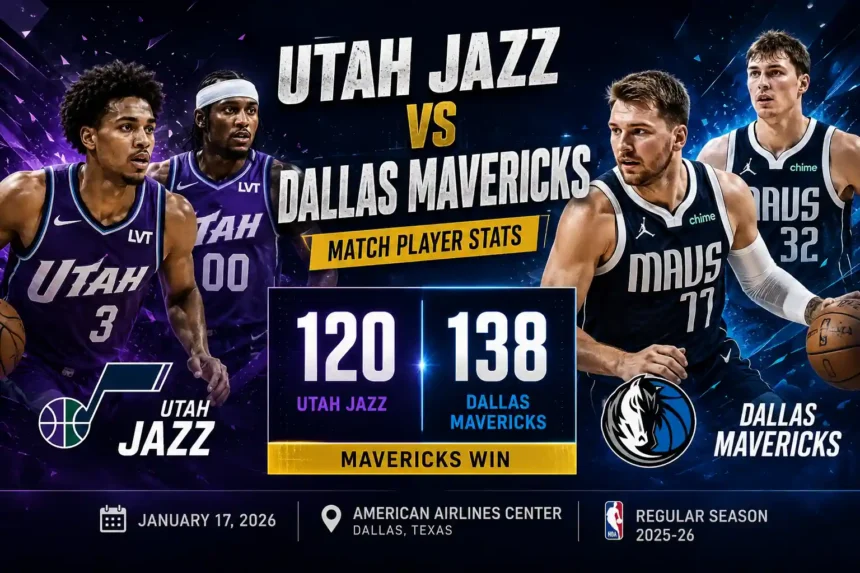
The latest Utah Jazz vs Dallas Mavericks match player stats come from Dallas’ 138–120 home victory on January 17, 2026. Klay Thompson led the Mavericks with 23 points, while Max Christie and Brandon Williams scored 22 each. Keyonte George produced a game-high 29 points for Utah, and Brice Sensabaugh added 25 from the bench. Dallas never trailed, recorded 35 assists and made 18 three-pointers to control the game from the opening quarter.
- Match Overview
- Utah Jazz vs Dallas Mavericks Match Player Stats: Leading Performers
- Dallas Mavericks Player Stats and Performance Analysis
- Klay Thompson: 23 Points and a Career Milestone
- Max Christie: 22 Points
- Brandon Williams: 22 Points
- Naji Marshall: 16 Points, 5 Rebounds and 6 Assists
- Dallas Bench Contributions
- Utah Jazz Player Stats and Performance Analysis
- Keyonte George: Game-High 29 Points
- Brice Sensabaugh: 25 Points off the Bench
- Ace Bailey: 18 Points
- Kyle Filipowski: 13 Points and 12 Rebounds
- Walter Clayton Jr.: Eight Assists
- Team Statistics That Decided the Game
- How Dallas Took Control in the First Quarter
- Utah’s Third-Quarter Comeback Attempt
- Three-Point Shooting Created Separation
- Ball Movement Was More Important Than Individual Scoring
- Turnovers Fueled Dallas’ Transition Offense
- Missing Players Changed the Matchup
- What the Result Meant for the Season Series
- Key Takeaways from the Player Stats
- Dallas Won Through Scoring Balance
- George Produced the Best Individual Scoring Performance
- Thompson’s Shooting Changed the Floor
- Dallas Protected the Ball
- Utah Needed More Defensive Resistance
- More Sports Profiles: Detroit Tigers vs Red Sox match player stats
- Conclusion
- Frequently Asked Questions
- Who won the latest Utah Jazz vs Dallas Mavericks game?
- Who scored the most points in the game?
- Who was the Mavericks’ leading scorer?
- Which Dallas players scored at least 20 points?
- Who recorded a double-double?
- How many three-pointers did Dallas make?
- Why did Cooper Flagg not play?
- What was the final Jazz–Mavericks season-series record?
Match Overview
The Dallas Mavericks defeated the Utah Jazz 138–120 at American Airlines Center in Dallas on January 17, 2026. It was the fourth and final regular-season meeting between the teams, leaving the season series tied at 2–2. Dallas opened the game with a 6–0 run and never surrendered the lead. The Mavericks made 12 of their first 16 field-goal attempts and finished the opening quarter ahead 42–29.
Utah attempted to respond after halftime. Keyonte George scored 19 points during the third quarter, helping the Jazz reduce the deficit to 106–94. However, Dallas answered every meaningful Utah run and pulled away again during the fourth quarter.
Match Details at a Glance
| Match detail | Information |
| Fixture | Utah Jazz at Dallas Mavericks |
| Date | January 17, 2026 |
| Venue | American Airlines Center, Dallas |
| Final score | Mavericks 138, Jazz 120 |
| Halftime leader | Dallas Mavericks |
| Top overall scorer | Keyonte George, 29 points |
| Dallas top scorer | Klay Thompson, 23 points |
| Season-series result | Tied 2–2 |
Utah Jazz vs Dallas Mavericks Match Player Stats: Leading Performers
The game featured balanced Dallas scoring and two major offensive performances for Utah.
| Player | Team | Points | Other notable statistics |
| Keyonte George | Utah Jazz | 29 | 9-of-15 FG, 4-of-6 3PT |
| Brice Sensabaugh | Utah Jazz | 25 | Major bench scoring contribution |
| Klay Thompson | Dallas Mavericks | 23 | 6 three-pointers |
| Max Christie | Dallas Mavericks | 22 | Part of Dallas’ three-player 20-point group |
| Brandon Williams | Dallas Mavericks | 22 | Strong early scoring and guard penetration |
| Ace Bailey | Utah Jazz | 18 | Helped Utah cut the fourth-quarter deficit |
| Naji Marshall | Dallas Mavericks | 16 | 5 rebounds and 6 assists |
| Kyle Filipowski | Utah Jazz | 13 | 12 rebounds |
| Jaden Hardy | Dallas Mavericks | 12 | Bench scoring |
George led all players with 29 points, while Thompson paced a Mavericks lineup in which three players reached at least 20 points.
Dallas Mavericks Player Stats and Performance Analysis
Klay Thompson: 23 Points and a Career Milestone
Klay Thompson scored 23 points in only 20 minutes. He made six of his 11 three-point attempts, with all six coming during the first half.
His performance was important for two reasons. First, his perimeter shooting helped Dallas establish a double-digit advantage before Utah could settle defensively. Second, he passed 17,000 career NBA points during the game.
Thompson did not need a high number of minutes or isolation possessions. Dallas created clean catch-and-shoot opportunities through penetration, quick passing and Utah’s defensive rotations.
His shooting line showed how efficiently he filled his role:
- 23 points
- 7-of-12 from the field
- 6-of-11 from three
- 3-of-3 at the free-throw line
Thompson’s early accuracy forced Utah to defend farther from the basket, opening driving lanes for Williams, Christie and Marshall.
Max Christie: 22 Points
Max Christie delivered one of Dallas’ three 20-point performances. His activity complemented Thompson’s outside shooting and gave the Mavericks another dependable scorer.
Christie was also involved in one of the game’s more physical moments. During the third quarter, Keyonte George pushed through a Dwight Powell screen, sending Powell into Christie. Officials assessed George a flagrant foul.
More importantly, Christie helped Dallas maintain its scoring level after the team’s fast start. Utah could not focus exclusively on Thompson because Christie and Williams continued attacking gaps in the defense.
Brandon Williams: 22 Points
Brandon Williams helped establish the tone immediately. He scored two early baskets as Dallas opened with six unanswered points.
His speed and dribble penetration repeatedly forced Utah’s guards to collapse toward the paint. That created passing lanes to shooters and helped Dallas produce one of its best ball-movement games of the season.
Williams’ 22 points made this the first game of the Mavericks’ season in which three Dallas players scored at least 20.
Naji Marshall: 16 Points, 5 Rebounds and 6 Assists
Naji Marshall provided one of the most complete performances of the game.
He finished with:
| Category | Total |
| Points | 16 |
| Rebounds | 5 |
| Assists | 6 |
Marshall tied the team-high mark in assists while adding efficient scoring and physical drives. His ability to operate in the paint became especially important after Utah reduced the margin early in the fourth quarter.
When the Jazz moved within 109–100, Marshall sparked a 7–0 Dallas run. That response stopped Utah’s momentum and restored the Mavericks’ comfortable advantage.
Dallas Bench Contributions
The Mavericks also received useful production from their supporting rotation.
Jaden Hardy scored 12 points, Miles Kelly added eight and Ryan Nembhard contributed seven. Their numbers may not have matched the leading scorers, but their minutes helped Dallas sustain its offensive pace.
The Mavericks did not depend on one player carrying the entire scoring load. Multiple guards could attack, pass or shoot, making Utah’s defensive assignments more difficult.
Utah Jazz Player Stats and Performance Analysis
Keyonte George: Game-High 29 Points
Keyonte George was Utah’s strongest offensive performer. He scored 29 points on 9-of-15 shooting, made four of six attempts from beyond the arc and converted seven of eight free throws.
His best stretch came during the third quarter, when he scored 19 points. Utah entered the period facing a large deficit, but George’s shot creation helped cut Dallas’ lead to 12 points before the fourth.
George scored from several areas:
- Pull-up and spot-up three-pointers
- Drives into the paint
- Free throws created through aggressive attacks
- Transition opportunities
His performance kept the game competitive longer than Dallas’ early dominance suggested. However, Utah needed more defensive stops to turn his scoring run into a complete comeback.
Brice Sensabaugh: 25 Points off the Bench
Brice Sensabaugh added 25 points as a reserve and gave Utah a second reliable scoring option.
Sensabaugh’s contribution mattered because Lauri Markkanen, Utah’s leading scorer at the time, was unavailable due to illness. Without Markkanen, the Jazz needed additional shot creation from their younger players.
Sensabaugh responded with another productive scoring performance, but Dallas’ balanced offense meant Utah could not close the gap through individual scoring alone.
Ace Bailey: 18 Points
Ace Bailey scored 18 points and played a role in Utah’s second-half push.
His putback reduced Dallas’ lead to 109–100 with 10:11 remaining in the fourth quarter. That was the closest Utah came during the final period.
Bailey’s scoring offered a positive sign, but Dallas immediately responded with a 7–0 run and rebuilt its advantage.
Kyle Filipowski: 13 Points and 12 Rebounds
Kyle Filipowski recorded a double-double with 13 points and 12 rebounds.
His rebounding total led the Jazz and gave them an interior presence. However, his work on the glass could not fully offset Dallas’ advantages in three-point shooting, passing and transition scoring.
Walter Clayton Jr.: Eight Assists
Walter Clayton Jr. led Utah with eight assists. His playmaking helped the Jazz generate offense around George, Sensabaugh and Bailey.
Utah still struggled to match Dallas’ overall passing production. The Mavericks finished with 35 assists, showing a wider distribution of playmaking across their rotation.
Team Statistics That Decided the Game
The most revealing Utah Jazz vs Dallas Mavericks match player stats were not limited to points. Dallas controlled several team categories that usually influence high-scoring NBA games.
| Team category | Dallas Mavericks | Utah Jazz | Main advantage |
| Final score | 138 | 120 | Dallas |
| Three-pointers made | 18 | Lower total | Dallas |
| Three-point shooting | 18-of-41, 44% | — | Dallas |
| Assists | 35 | Lower total | Dallas |
| Turnovers | 11 | 15 | Dallas |
| Fast-break points | 30 | — | Dallas |
| First-quarter score | 42 | 29 | Dallas |
Dallas combined efficient three-point shooting with excellent ball security. The Mavericks’ 35 assists against only 11 turnovers represented an assist-to-turnover ratio of more than 3-to-1.
How Dallas Took Control in the First Quarter
The Mavericks won the game’s opening phase through pace, shooting and decisive ball movement.
Dallas made seven of 12 three-point attempts in the first quarter and scored 42 points. Utah struggled to defend the first action and the next pass. When defenders collapsed against penetration, Dallas quickly moved the ball to an open shooter.
The Mavericks also avoided empty possessions. Their early execution meant Utah was frequently taking the ball out of the net rather than generating transition attacks.
By the end of the first quarter, Dallas had built a 42–29 lead and controlled both the tempo and shot quality.
Utah’s Third-Quarter Comeback Attempt
Utah’s best period came after halftime.
George attacked more aggressively and scored 19 points in the third quarter. The Jazz began creating better offensive possessions and reduced the margin to 106–94 entering the fourth.
This stretch showed that Utah could challenge Dallas when it played faster and placed the ball in George’s hands. However, the comeback required a high level of individual shot-making. Utah still struggled to create enough defensive stops at the other end.
Once Dallas regained its offensive rhythm, the Jazz could not reduce the margin below nine points.
Three-Point Shooting Created Separation
Dallas made 18 of 41 shots from beyond the arc, equal to approximately 44%.
Thompson led the team with six made three-pointers, but the overall result came from collective shot creation. Drives forced Utah’s defense inward, and Dallas consistently found open teammates around the perimeter.
The Mavericks had also made 19 three-pointers against Utah two days earlier. Across the two consecutive home games, their shooting repeatedly exposed the Jazz’s difficulty defending the perimeter.
Dallas did not simply take more outside shots. It created many of them through movement rather than forced isolation attempts.
Ball Movement Was More Important Than Individual Scoring
Three Dallas players scored more than 20 points, but the Mavericks’ 35 assists may have been the clearest sign of their offensive control.
The ball rarely remained with one player for an entire possession. Williams, Marshall and other ball handlers repeatedly entered the paint before passing to cutters or perimeter shooters.
This approach made Dallas less predictable. Utah could not solve the offense by stopping one primary creator.
The Mavericks tied their season-high total of 35 assists while committing only 11 turnovers.
Turnovers Fueled Dallas’ Transition Offense
Utah committed 15 turnovers, and Dallas converted those mistakes into 30 fast-break points.
That was a major difference because transition opportunities allowed the Mavericks to attack before Utah could organize its defense.
Dallas, meanwhile, committed only 11 turnovers. That four-turnover difference appears modest, but the quality of the resulting opportunities made it significant.
The Mavericks turned live-ball mistakes into:
- Open three-pointers
- Drives against retreating defenders
- Early passing opportunities
- Cross-matches and defensive confusion
Utah’s turnovers therefore affected both ends of the floor. They ended potential Jazz scoring possessions and immediately created efficient Dallas attacks.
Missing Players Changed the Matchup
Both teams entered the game without important players.
Dallas was missing Cooper Flagg because of a left ankle sprain. Anthony Davis, P.J. Washington, Daniel Gafford and D’Angelo Russell were also among the unavailable Mavericks rotation players.
Utah played without leading scorer Lauri Markkanen, who was sidelined by illness. Jusuf Nurkić also did not play.
These absences gave younger players and reserves larger roles. Dallas adapted more successfully because its available guards produced balanced scoring, maintained ball movement and limited turnovers.
Utah found enough offense through George and Sensabaugh, but its defense could not contain Dallas’ depth.
What the Result Meant for the Season Series
The January 17 game completed the four-match regular-season series between the teams.
Utah won the first two meetings:
- December 15, 2025: Jazz 140, Mavericks 133 in overtime
- January 8, 2026: Jazz 116, Mavericks 114
Dallas won the final two:
- January 15, 2026: Mavericks 144, Jazz 122
- January 17, 2026: Mavericks 138, Jazz 120
The final season series ended 2–2. Dallas’ two victories were particularly convincing, with the Mavericks scoring 282 combined points across the back-to-back home wins.
Key Takeaways from the Player Stats
Dallas Won Through Scoring Balance
Thompson led the Mavericks, but Christie and Williams were only one point behind him. Marshall also added scoring, rebounding and playmaking.
This balance prevented Utah from concentrating its defense on one player.
George Produced the Best Individual Scoring Performance
George’s 29 points were the highest total in the game. His third-quarter run gave Utah a chance to make the contest competitive.
However, Dallas received more production across its full rotation.
Thompson’s Shooting Changed the Floor
Six made three-pointers in 20 minutes forced Utah to stretch its defense. His gravity helped create space for Dallas’ guards to attack.
Dallas Protected the Ball
The Mavericks’ 35 assists and 11 turnovers demonstrated controlled, unselfish offense. Utah’s 15 turnovers contributed directly to 30 Dallas fast-break points.
Utah Needed More Defensive Resistance
The Jazz scored 120 points, which is often enough to remain competitive. Allowing 138 was the larger problem.
Dallas scored 42 in the first quarter and reached at least 70 points by halftime for the second consecutive game against Utah.
More Sports Profiles: Detroit Tigers vs Red Sox match player stats
Conclusion
The latest Utah Jazz vs Dallas Mavericks match player stats show that Dallas won through much more than individual scoring. The Mavericks combined 18 made three-pointers, 35 assists, disciplined ball control and 30 fast-break points in a convincing 138–120 victory. Keyonte George delivered the game’s highest scoring total, and Brice Sensabaugh gave Utah valuable bench production. Dallas, however, received 20-point performances from Thompson, Christie and Williams, alongside an all-around contribution from Marshall. The defining difference was collective execution. Dallas created better shots, moved the ball more effectively and punished Utah’s turnovers. Those advantages allowed the Mavericks to lead from the opening minutes and complete the season series with a dominant second consecutive win.
Frequently Asked Questions
Who won the latest Utah Jazz vs Dallas Mavericks game?
The Dallas Mavericks won 138–120 on January 17, 2026, at American Airlines Center in Dallas.
Who scored the most points in the game?
Utah guard Keyonte George led all scorers with 29 points. He shot 9-of-15 from the field and made four three-pointers.
Who was the Mavericks’ leading scorer?
Klay Thompson led Dallas with 23 points in 20 minutes. He made six of 11 three-point attempts.
Which Dallas players scored at least 20 points?
Klay Thompson scored 23, while Max Christie and Brandon Williams each scored 22.
Who recorded a double-double?
Kyle Filipowski recorded a double-double for Utah with 13 points and 12 rebounds.
How many three-pointers did Dallas make?
The Mavericks made 18 of 41 three-point attempts, shooting approximately 44% from beyond the arc.
Why did Cooper Flagg not play?
Cooper Flagg missed the game because of a left ankle sprain. It was his second consecutive absence.
What was the final Jazz–Mavericks season-series record?
The teams split their four regular-season games, finishing the series tied 2–2.