




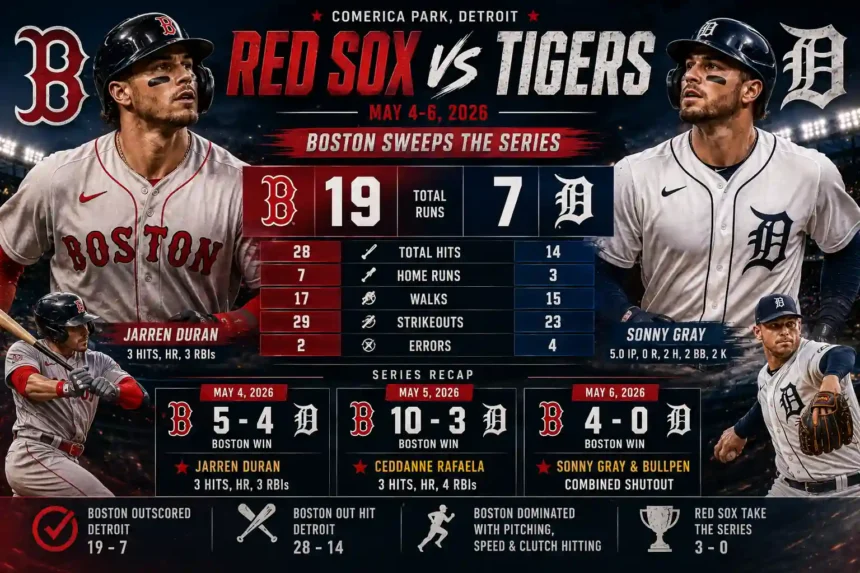
The latest Detroit Tigers vs Red Sox match player stats show that Boston controlled the teams’ May 4–6, 2026 series at Comerica Park. The Red Sox won all three games, taking the opener 5–4, winning the second game 10–3, and completing the sweep with a 4–0 shutout. Jarren Duran delivered the biggest hit of the opener, Ceddanne Rafaela powered the blowout victory, and Boston’s pitching staff held Detroit scoreless in the finale.
- Tigers vs Red Sox Results at a Glance
- Latest Detroit Tigers vs Red Sox Match Player Stats
- May 4: Duran Changes the Game in One Inning
- Jarren Duran’s decisive performance
- Payton Tolle’s unusual pitching line
- Detroit’s strongest performers
- May 5: Boston’s Lineup Produces a 10-Run Breakout
- Ceddanne Rafaela leads the attack
- Wilyer Abreu adds three hits
- Brayan Bello controls Detroit
- Detroit’s limited response
- Top Red Sox Players Across the Three-Game Series
- Detroit’s Best Individual Performances
- Why Boston’s Pitching Won the Series
- The Innings That Decided the Series
- Boston’s five-run seventh on May 4
- Boston’s five-run third on May 5
- Detroit’s missed opportunity on May 6
- Complete 2026 Season-Series Context
- What the Numbers Reveal
- More Sports Profiles: LA Clippers vs Utah Jazz Match Player Stats
- Conclusion
- Frequently Asked Questions
- Who won the latest Tigers vs Red Sox game?
- Who had the best player stats in the May series?
- Who hit the decisive home run in the first game?
- Which Boston pitcher had the best performance?
- Which Tigers hitter performed most consistently?
- How many runs did Boston score in the three games?
- Did the Red Sox sweep the Tigers?
- What was the 2026 head-to-head record?
Tigers vs Red Sox Results at a Glance
| Date | Winner | Score | Defining performance |
| May 4, 2026 | Boston | 5–4 | Jarren Duran: three hits, home run, three RBIs |
| May 5, 2026 | Boston | 10–3 | Ceddanne Rafaela: three hits, home run, four RBIs |
| May 6, 2026 | Boston | 4–0 | Sonny Gray and Boston’s bullpen combined for a shutout |
Across the three games, Boston outscored Detroit 19–7 and outhit the Tigers 28–14. The series was not simply a case of Boston producing more home runs. The Red Sox also received longer and more effective pitching appearances, created scoring opportunities throughout the lineup and capitalized on Detroit’s bullpen and defensive mistakes.
Latest Detroit Tigers vs Red Sox Match Player Stats
The most recent meeting took place on May 6, 2026, at Comerica Park. Boston won 4–0 to finish the three-game sweep.
Both teams recorded four hits, but the similarity ended there. Boston drew seven walks, stole three bases and benefited from a Detroit fielding error. The Tigers drew five walks but went scoreless despite putting several runners on base.
May 6 team totals
| Team | Runs | Hits | Errors | Walks | Strikeouts |
| Boston Red Sox | 4 | 4 | 0 | 7 | 15 |
| Detroit Tigers | 0 | 4 | 1 | 5 | 7 |
Boston scored twice in the third inning and twice in the fourth. Detroit never recovered, even though Jack Flaherty produced an unusual pitching line: 10 strikeouts in five innings but four runs allowed, only two of which were earned.
Boston batting leaders
Masataka Yoshida was Boston’s only player with multiple hits, finishing 2-for-4 and scoring a run. Marcelo Mayer added a hit, a walk and a run, while Caleb Durbin drove in a run with a double.
Willson Contreras did not record a hit, but his sacrifice fly brought home Boston’s second run. Ceddanne Rafaela also went hitless, yet two walks allowed him to reach base and score.
That distribution matters. The Red Sox did not need a home run or a large hit total because several players contributed through walks, baserunning and situational hitting.
Detroit batting leaders
Riley Greene produced two of Detroit’s four hits, including a double. Matt Vierling and Colt Keith recorded the other two.
Greene’s second-inning double gave the Tigers an early opportunity. Walks to Zach McKinstry and Spencer Torkelson later loaded the bases, but Jace Jung lined out to end the threat. Detroit continued to put runners on base but could not produce the hit needed to change the game.
Pitching comparison
| Pitcher | Team | IP | H | R | ER | BB | SO |
| Sonny Gray | Boston | 5.0 | 4 | 0 | 0 | 2 | 2 |
| Jack Flaherty | Detroit | 5.0 | 3 | 4 | 2 | 1 | 10 |
Gray was returning from a hamstring injury and threw 70 pitches. He allowed four hits and two walks but prevented Detroit from scoring.
Boston then received four hitless innings from Tayler Samaniego, Zack Kelly and Greg Weissert. Those three relievers combined for five walks and five strikeouts, yet Detroit could not turn the additional baserunners into runs.
Flaherty’s 10 strikeouts demonstrate why pitcher evaluation requires more than one statistic. He missed bats effectively and allowed only three hits, but Detroit’s error and Boston’s walks and baserunning turned limited contact into four runs.
May 4: Duran Changes the Game in One Inning
The first game was the closest and most dramatic contest of the May series. Detroit led 2–0 after six innings before Boston scored five times in the seventh and held on for a 5–4 victory.
Jarren Duran’s decisive performance
Duran went 3-for-5 with a home run, three RBIs and a stolen base. His opposite-field three-run homer in the seventh transformed a 2–0 deficit into a 3–2 Boston lead.
Wilyer Abreu and Marcelo Mayer then added RBI singles, extending the lead to 5–2. Those insurance runs became essential when Detroit scored twice in the eighth.
Duran’s home run was the defining play, but his overall line also showed his broader influence. He produced one-quarter of Boston’s 12 hits and was responsible for three of the team’s five runs.
Payton Tolle’s unusual pitching line
Payton Tolle allowed only one hit over seven innings and struck out eight. Detroit scored twice against him, but both runs were unearned.
That distinction is important. Tolle limited hard contact and controlled the strike zone, while Boston’s defensive mistakes created Detroit’s opening. He completed seven innings on 83 pitches and received the win.
Detroit’s strongest performers
Matt Vierling drove in Detroit’s first two runs. Dillon Dingler later hit a two-run double in the eighth, reducing Boston’s lead to one.
Riley Greene recorded a double, but the Tigers finished with only three hits. Spencer Torkelson went 0-for-4 with three strikeouts, leaving Detroit without enough production from the middle of the order.
Ty Madden gave Detroit five scoreless innings with seven strikeouts. The game changed after he departed. Ricky Vanasco allowed four runs in two-thirds of an inning, turning Detroit’s late lead into a deficit.
May 5: Boston’s Lineup Produces a 10-Run Breakout
The second game delivered the clearest offensive mismatch. Boston scored three runs in the first, five in the third and two in the fourth on the way to a 10–3 victory.
Ceddanne Rafaela leads the attack
Rafaela went 3-for-5 with two runs, a home run and four RBIs. His three-run homer in the first inning immediately put Detroit under pressure.
He added an RBI single during Boston’s five-run third inning. That made him directly responsible for four of the Red Sox’s first eight runs.
This was the strongest all-around offensive performance of the series. Rafaela combined power with repeated contact and delivered in two different scoring innings.
Wilyer Abreu adds three hits
Abreu finished 3-for-4 with two runs, a walk, a solo home run and one RBI. He reached base four times and gave Boston a productive presence near the top of the order.
Willson Contreras also homered and scored twice. Trevor Story scored two runs, while Caleb Durbin collected two hits and an RBI. Boston’s production came from nearly every part of the lineup rather than one isolated hitter.
Brayan Bello controls Detroit
Brayan Bello entered after opener Jovani Morán and delivered seven innings of one-run baseball. He allowed four hits, walked one and struck out seven.
Detroit did not score against Bello until the fifth inning. By then, Boston already led 10–2. Bello’s length protected the bullpen and prevented the Tigers from creating a meaningful comeback.
Detroit’s limited response
Matt Vierling homered in the first inning. Wenceel Pérez added an RBI single later in the frame, and Dillon Dingler drove in Detroit’s final run in the fifth.
Those moments provided some resistance, but the Tigers could not match Boston’s sustained production. Detroit recorded seven hits compared with Boston’s 12 and did not score after the fifth inning.
Framber Valdez allowed 10 runs and three home runs before leaving in the fourth. The game also included a benches-clearing incident after Valdez hit Story with a pitch, although no punches were thrown.
Top Red Sox Players Across the Three-Game Series
Ceddanne Rafaela
Rafaela was the series’ most complete position player.
He finished the three games 5-for-12 with:
- One home run
- Four RBIs
- Three runs
- Two walks
- One stolen base
Almost all of his run production came in the 10–3 victory, but he also collected two hits in the opener and reached base twice in the finale. His combination of contact, power and speed gave Boston several ways to generate offense.
Jarren Duran
Duran went 3-for-13 with one home run, three RBIs and two walks.
Those series totals appear modest until the context is considered. All three hits and all three RBIs came in the opener, where his seventh-inning home run reversed the result. One decisive swing carried more value than several low-leverage hits would have produced.
Wilyer Abreu
Abreu went 4-for-13 with a home run, two RBIs, two runs and two walks.
He delivered an RBI single immediately after Duran’s homer in Game 1 and reached base four times in Game 2. His home run in the fourth inning of the second game helped turn a large lead into an insurmountable one.
Masataka Yoshida
Yoshida recorded four hits in eight at-bats and scored twice. He collected two hits in the opener after replacing the injured Roman Anthony and added two more in the shutout victory.
He did not record an RBI, but his ability to reach base helped extend innings and gave the lower half of Boston’s order additional opportunities.
Detroit’s Best Individual Performances
Riley Greene
Greene was Detroit’s most consistent hitter in the series, going 4-for-12 with two doubles.
He recorded one hit in each of the first two games and went 2-for-4 in the finale. His numbers show that he was seeing the ball well, but Detroit struggled to bring him home or turn his extra-base hits into sustained rallies.
Matt Vierling
Vierling contributed in each of Detroit’s scoring games. He drove in two runs during the opener and homered in the first inning of Game 2.
He also reached base twice in the finale, recording a hit and a walk. His production was valuable, although it was not supported consistently by the hitters behind him.
Dillon Dingler
Dingler drove in three runs across the first two games. His two-run double gave Detroit a chance in the opener, while his fifth-inning single produced the Tigers’ final run of Game 2.
The catcher struggled in the finale, going 0-for-4 and leaving five runners on base. His series illustrates Detroit’s broader problem: productive moments appeared, but they did not continue from one game to the next.
Ty Madden and Jack Flaherty
Madden supplied Detroit’s best run-prevention performance, throwing five scoreless innings with seven strikeouts in the opener.
Flaherty’s finale was more complicated. He struck out 10 and allowed only three hits, but Boston scored four runs against him. Two were unearned, showing how walks, stolen bases and defensive mistakes reduced the value of his strikeout total.
Why Boston’s Pitching Won the Series
Boston’s three main pitchers—Tolle, Bello and Gray—combined for 19 innings, nine hits allowed, three runs and only one earned run.
Their combined line was:
| Pitcher | IP | H | R | ER | BB | SO |
| Payton Tolle | 7.0 | 1 | 2 | 0 | 1 | 8 |
| Brayan Bello | 7.0 | 4 | 1 | 1 | 1 | 7 |
| Sonny Gray | 5.0 | 4 | 0 | 0 | 2 | 2 |
| Combined | 19.0 | 9 | 3 | 1 | 4 | 17 |
Tolle and Bello both worked seven innings, reducing the number of outs Boston needed from its bullpen. Gray worked only five in the finale, but four relievers protected the shutout without allowing a hit.
Detroit received a strong outing from Madden and a high-strikeout performance from Flaherty. The difference was consistency. One bullpen collapse decided the opener, Valdez’s difficult start decided Game 2, and an error contributed to the damage in Game 3.
The Innings That Decided the Series
Boston’s five-run seventh on May 4
Detroit was six outs away from taking the opener when Boston turned a 2–0 deficit into a 5–2 lead.
Duran’s three-run homer created the lead, while Abreu and Mayer supplied the insurance runs. It was the clearest example of Boston combining a star moment with lineup depth.
Boston’s five-run third on May 5
The Red Sox entered the inning ahead 3–2 and produced five consecutive singles during the rally.
Rafaela, Andruw Monasterio, Durbin, Connor Wong and Isiah Kiner-Falefa each contributed to the scoring sequence. Rather than waiting for another homer, Boston kept the inning alive through repeated contact.
Detroit’s missed opportunity on May 6
Detroit loaded the bases in the second inning with one out but did not score. Jung lined out, and Boston escaped the inning.
The Tigers continued to receive walks later in the game, yet their four hits never arrived at the right time. That failure with runners on base allowed Boston to protect a modest four-run lead comfortably.
Complete 2026 Season-Series Context
The teams first met for four games at Fenway Park from April 17–20.
Boston won the opener 1–0. Detroit responded with victories of 4–1 and 6–2 before the Red Sox won the Patriots’ Day finale 8–6, producing a 2–2 split.
Boston’s three-game sweep at Comerica Park therefore gave the Red Sox a 5–2 advantage across the seven 2026 meetings.
The sequence also showed how quickly matchup trends can change. Detroit won two of the first three games, supported by strong pitching. Boston then won four consecutive meetings, scoring 27 runs across the April finale and the three May games.
What the Numbers Reveal
The Detroit Tigers vs Red Sox match player stats point to five clear conclusions.
First, Boston received the most influential individual performances. Duran changed the opener, Rafaela dominated Game 2 and Gray led the shutout.
Second, Boston’s offensive depth mattered. Yoshida, Abreu, Mayer, Contreras, Durbin and other supporting hitters contributed even when Duran or Rafaela did not produce.
Third, Detroit’s offense was too dependent on isolated moments. Vierling, Greene and Dingler had productive at-bats, but the Tigers rarely connected those performances within the same inning.
Fourth, strikeout totals did not always predict the result. Flaherty struck out 10 and lost, while Gray struck out only two and won. Preventing walks, avoiding errors and controlling scoring situations were more important in the finale.
Finally, Boston won the leverage innings. The Red Sox scored five runs in the seventh inning of Game 1 and five in the third inning of Game 2. Detroit’s biggest rallies came after Boston had already taken control.
More Sports Profiles: LA Clippers vs Utah Jazz Match Player Stats
Conclusion
Boston’s May sweep was built on more than one hot hitter. Duran supplied the biggest swing of the opener, Rafaela led the 10-run breakout, and Gray helped secure the shutout. Tolle and Bello provided length, while Boston’s supporting hitters repeatedly extended innings. Detroit received encouraging performances from Greene, Vierling, Dingler, Madden and Flaherty. However, the Tigers could not combine timely hitting, clean defense and reliable pitching in the same game.
The final scores tell only part of the story. The fuller statistical picture shows that Boston won because it created more scoring opportunities, converted them in high-leverage innings and received dependable pitching throughout the series.
Frequently Asked Questions
Who won the latest Tigers vs Red Sox game?
Boston won the latest meeting 4–0 on May 6, 2026, at Comerica Park. The victory completed a three-game Red Sox sweep.
Who had the best player stats in the May series?
Ceddanne Rafaela delivered the strongest overall position-player performance. He went 5-for-12 with a home run, four RBIs, three runs, two walks and a stolen base.
Who hit the decisive home run in the first game?
Jarren Duran hit a three-run home run in the seventh inning of the May 4 opener. It changed Boston’s 2–0 deficit into a 3–2 lead.
Which Boston pitcher had the best performance?
Payton Tolle had the most dominant statistical line. He allowed one hit and no earned runs over seven innings while striking out eight. Sonny Gray also delivered five scoreless innings in the series finale.
Which Tigers hitter performed most consistently?
Riley Greene was Detroit’s most consistent hitter in the three-game series. He collected four hits in 12 at-bats, including two doubles.
How many runs did Boston score in the three games?
Boston scored 19 runs: five in the opener, 10 in Game 2 and four in the finale.
Did the Red Sox sweep the Tigers?
Yes. Boston won all three games played at Comerica Park from May 4 through May 6, 2026.
What was the 2026 head-to-head record?
Boston won five of the seven regular-season meetings covered here. The teams split four games at Fenway Park before Boston swept the three-game series in Detroit.