




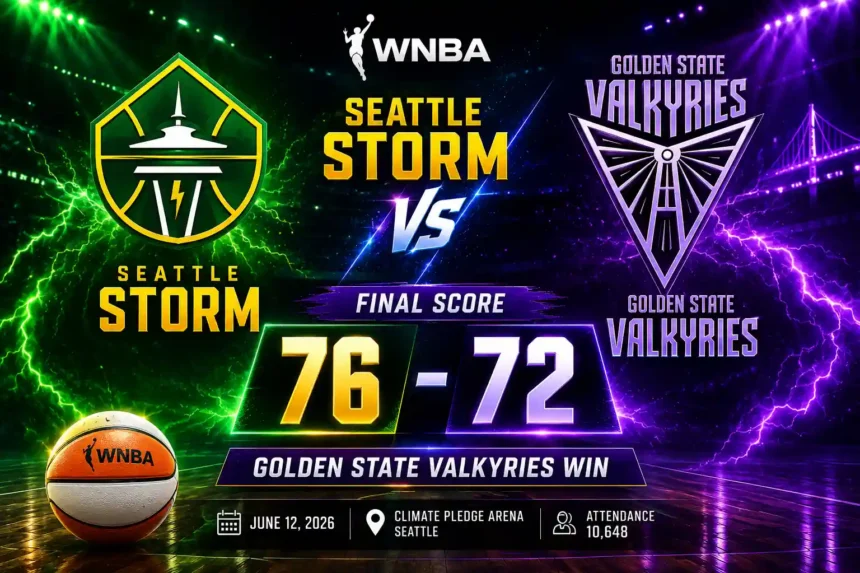
The latest Seattle Storm vs Golden State Valkyries Match Player Stats show Golden State winning 76-72 at Climate Pledge Arena on June 12, 2026. Janelle Salaün led the Valkyries with 22 points and five three-pointers, while Gabby Williams scored 19 and Tiffany Hayes added 17 off the bench. Seattle guard Natisha Hiedeman delivered the game’s biggest individual scoring performance with a career-high 26 points, but Golden State’s third-quarter surge, 40 bench points and 20 made free throws proved decisive.
- Seattle Storm vs Golden State Valkyries Match Player Stats: Quick Result
- Complete Golden State Valkyries Player Stats
- Janelle Salaün supplied the scoring and spacing
- Gabby Williams kept attacking
- Tiffany Hayes changed the game from the bench
- Veronica Burton controlled the offense
- Complete Seattle Storm Player Stats
- Natisha Hiedeman delivered the best scoring line
- Seattle needed a second high-volume scorer
- Jordan Horston contributed across the box score
- Team Stats That Decided the 76-72 Game
- Free throws erased Golden State’s shooting problems
- The bench gap shaped the rotation battle
- The third quarter created the winning margin
- Golden State survived a difficult fourth quarter
- What the Player Stats Reveal About Each Team
- Storm vs Valkyries Head-to-Head Context
- How to Read These Match Player Stats
- More Sports Profiles: Carolina Panthers vs Jacksonville Jaguars Match Player Stats
- Conclusion
- Frequently Asked Questions
- Who won the latest Seattle Storm vs Golden State Valkyries game?
- Who scored the most points in the match?
- How many three-pointers did Janelle Salaün make?
- What were Veronica Burton’s stats?
- Why did Golden State win despite shooting worse?
- What was the biggest turning point?
- How close did Seattle come to completing the comeback?
- Where can fans verify the full box score?
Seattle Storm vs Golden State Valkyries Match Player Stats: Quick Result
| Game detail | Result |
| Date | June 12, 2026 |
| Venue | Climate Pledge Arena, Seattle |
| Final score | Golden State Valkyries 76, Seattle Storm 72 |
| Leading scorer | Natisha Hiedeman, Seattle — 26 points |
| Golden State leader | Janelle Salaün — 22 points |
| Rebounding leaders | Dominique Malonga, Seattle — 8; Salaün, Golden State — 7 |
| Assist leader | Veronica Burton, Golden State — 8 |
| Decisive period | Golden State won the third quarter 26-15 |
| Attendance | 10,648 |
The final margin was only four points, but the game had two very different phases. Golden State controlled the middle portion, built a 15-point advantage and entered the fourth quarter ahead 66-53.
Seattle then closed with a 19-10 final period and reduced the deficit to one possession. The Valkyries survived by reaching the free-throw line, converting under pressure and producing one final defensive stop.
Quarter-by-quarter score
| Team | Q1 | Q2 | Q3 | Q4 | Final |
| Golden State Valkyries | 21 | 19 | 26 | 10 | 76 |
| Seattle Storm | 21 | 17 | 15 | 19 | 72 |
The teams were tied after the opening quarter, and Golden State led by only two at halftime. The game changed immediately after the break.
A 19-6 Valkyries run helped create a 59-44 advantage, giving Golden State enough room to withstand a difficult fourth quarter in which it made only one of 16 field-goal attempts.
Complete Golden State Valkyries Player Stats
| Player | MIN | PTS | REB | AST | STL | BLK | FG | 3PT | FT | +/- |
| Gabby Williams | 32:12 | 19 | 1 | 4 | 1 | 0 | 6-16 | 2-7 | 5-5 | -2 |
| Kayla Thornton | 24:12 | 2 | 4 | 1 | 1 | 2 | 1-7 | 0-4 | 0-0 | -8 |
| Kiah Stokes | 22:44 | 2 | 5 | 1 | 1 | 1 | 1-1 | 0-0 | 0-0 | +7 |
| Cecilia Zandalasini | 12:51 | 2 | 2 | 0 | 1 | 1 | 1-6 | 0-3 | 0-0 | -5 |
| Veronica Burton | 30:11 | 11 | 5 | 8 | 2 | 1 | 3-9 | 1-5 | 4-6 | +2 |
| Kaitlyn Chen | 9:49 | 0 | 2 | 0 | 0 | 0 | 0-1 | 0-1 | 0-0 | +2 |
| Janelle Salaün | 33:04 | 22 | 7 | 1 | 0 | 0 | 7-14 | 5-12 | 3-3 | +9 |
| Tiffany Hayes | 23:45 | 17 | 4 | 3 | 0 | 0 | 5-9 | 0-2 | 7-7 | +10 |
| Kaila Charles | 11:12 | 1 | 3 | 0 | 0 | 1 | 0-3 | 0-3 | 1-2 | +5 |
Laeticia Amihere, Nadia Fingall and Justė Jocytė did not play by coach’s decision. Golden State shot 24-of-66 from the field, 8-of-37 from three and 20-of-23 at the free-throw line.
Janelle Salaün supplied the scoring and spacing
Salaün produced the strongest offensive line for the winners: 22 points, seven rebounds and five made threes in just over 33 minutes. She shot 7-of-14 overall and 5-of-12 from deep.
Her perimeter production was particularly important because the rest of the Valkyries combined to make only three of their 25 three-point attempts.
Salaün’s fifth triple gave Golden State a 69-57 lead with 4:23 remaining. That basket became increasingly valuable when the Valkyries failed to make another field goal.
Her shot creation and floor spacing therefore did more than increase her point total. They created the cushion Golden State needed during Seattle’s late rally.
Gabby Williams kept attacking
Williams scored 19 points against her former team. Her 6-of-16 field-goal line was not especially efficient, but she added four assists, made two three-pointers and converted all five of her free throws.
Her late foul shots were critical. Seattle moved within one point with 13.4 seconds remaining, but Williams responded by making two free throws for a 75-72 advantage.
That changed Seattle’s final possession. The Storm needed a three-pointer rather than being able to play for a tying two-point basket.
Tiffany Hayes changed the game from the bench
Hayes scored 17 points in 23:45 and recorded a team-best plus-10. She made five of nine field-goal attempts and all seven of her free throws.
Those figures help explain much of Golden State’s edge in bench scoring. Hayes alone scored more points than Seattle’s entire bench.
The “bench” label can also be misleading. Hayes played more minutes than two Golden State starters, handled important late possessions and took the pressure free throws that protected the lead. Her role was closer to that of a closer than a conventional reserve.
Veronica Burton controlled the offense
Burton finished with 11 points, eight assists, five rebounds, two steals and one block. Her shooting was modest at 3-of-9, but her passing supplied structure to an offense that relied heavily on Salaün, Williams and Hayes.
Eight assists against three turnovers gave Golden State a dependable primary creator. Burton contributed in every major area of the box score, making hers one of the game’s most balanced performances.
Complete Seattle Storm Player Stats
| Player | MIN | PTS | REB | AST | STL | BLK | FG | 3PT | FT | +/- |
| Jordan Horston | 25:42 | 5 | 5 | 5 | 2 | 2 | 2-7 | 0-2 | 1-2 | -5 |
| Awa Fam | 34:42 | 8 | 6 | 1 | 0 | 1 | 3-9 | 2-5 | 0-2 | +6 |
| Dominique Malonga | 24:37 | 9 | 8 | 2 | 0 | 1 | 3-10 | 0-0 | 3-3 | -7 |
| Flau’jae Johnson | 28:53 | 8 | 5 | 1 | 0 | 0 | 4-9 | 0-2 | 0-0 | +8 |
| Natisha Hiedeman | 32:31 | 26 | 4 | 5 | 2 | 1 | 8-17 | 5-10 | 5-7 | +1 |
| Stefanie Dolson | 7:31 | 3 | 1 | 0 | 0 | 0 | 1-1 | 1-1 | 0-0 | -3 |
| Jade Melbourne | 26:59 | 5 | 0 | 2 | 2 | 0 | 2-7 | 0-1 | 1-2 | 0 |
| Zia Cooke | 3:38 | 0 | 1 | 0 | 0 | 0 | 0-4 | 0-0 | 0-0 | -11 |
| Mackenzie Holmes | 3:34 | 0 | 0 | 1 | 0 | 0 | 0-0 | 0-0 | 0-0 | -4 |
| Katie Lou Samuelson | 11:54 | 8 | 1 | 0 | 0 | 0 | 2-2 | 2-2 | 2-2 | -5 |
Ezi Magbegor did not dress because of injury or illness, while Taylor Thierry did not play by coach’s decision. Seattle finished 25-of-66 from the floor, 10-of-23 from three and 12-of-18 at the line.
Natisha Hiedeman delivered the best scoring line
Hiedeman scored a career-high 26 points while adding five assists, four rebounds, two steals and one block. She made eight of 17 field-goal attempts and five of 10 three-pointers.
Her performance kept Seattle within striking distance during Golden State’s strongest stretch and provided the Storm with a reliable scoring option during the late comeback.
Seattle made 10 threes as a team, with Hiedeman accounting for half of them. She also scored more than one-third of the Storm’s total points.
Seattle needed a second high-volume scorer
The other four Seattle starters combined for 30 points. Malonga recorded nine points and eight rebounds, while Fam and Johnson added eight points each.
Those were useful contributions, but no second starter reached double figures. That imbalance placed too much half-court responsibility on Hiedeman.
When Golden State pressured the ball or forced another player to initiate the offense, Seattle had fewer reliable ways to create an efficient shot. Samuelson’s perfect eight-point performance in under 12 minutes helped, but the Storm reserves scored only 16 points collectively.
Jordan Horston contributed across the box score
Horston scored only five points, but she added five rebounds, five assists, two steals and two blocks.
Her line demonstrates why scoring alone cannot measure a player’s contribution. She helped Seattle defend, move the ball and contest shots.
The limitation was shooting efficiency. Horston went 2-of-7 and did not make a three, allowing Golden State to direct more defensive attention toward Hiedeman.
Team Stats That Decided the 76-72 Game
| Category | Golden State | Seattle | Advantage |
| Field goals | 24-66, 36.4% | 25-66, 37.9% | Seattle |
| Three-pointers | 8-37, 21.6% | 10-23, 43.5% | Seattle |
| Free throws | 20-23, 87.0% | 12-18, 66.7% | Golden State |
| Rebounds | 33 | 31 | Golden State |
| Assists | 18 | 17 | Golden State |
| Turnovers | 13 | 11 | Seattle |
| Bench points | 40 | 16 | Golden State |
| Points in the paint | 20 | 28 | Seattle |
| Fast-break points | 10 | 8 | Golden State |
Seattle shot a higher percentage from the field and from three, committed fewer turnovers and scored more points in the paint. In many games, that combination produces a victory.
Golden State overcame those disadvantages through two categories with direct scoreboard value: free throws and bench scoring.
Free throws erased Golden State’s shooting problems
The Valkyries made eight more free throws than the Storm. That advantage offset Seattle’s superior perimeter shooting.
Seattle gained six points by making two more three-pointers, while Golden State offset that advantage by scoring eight more points from the free-throw line.
Golden State also converted at an 87% rate, compared with Seattle’s 66.7%. In a four-point game, those missed Storm opportunities were significant.
Hayes went 7-of-7, Williams finished 5-of-5 and Salaün made all three of her attempts. Golden State’s three leading scorers were therefore a combined 15-of-15 from the line.
The bench gap shaped the rotation battle
Golden State’s 40-16 advantage in bench points was the clearest structural difference between the teams.
Hayes alone outscored Seattle’s reserve group 17-16. Salaün also entered from the bench in the official box score and led Golden State with 22 points.
That shows why a simple starter-versus-starter comparison would not explain the result. Golden State’s strongest offensive players were not determined by who opened the game.
The Valkyries could introduce two primary scorers through their changing rotations and maintain offensive creation while Seattle’s starters rested.
The third quarter created the winning margin
Golden State’s 26-15 third quarter produced an 11-point swing. The Valkyries entered halftime leading by two and began the fourth with a 13-point advantage.
Every other period either favored Seattle or ended level. The third quarter was therefore the central tactical story of the game.
Golden State found earlier offense, stretched Seattle’s defense and established a large enough lead before its shooting collapsed in the final period. Without that quarter, the Storm’s strong finish would have completed the comeback.
Golden State survived a difficult fourth quarter
The Valkyries went 1-of-16 from the field in the fourth quarter. Seattle reduced a 12-point deficit after Salaün’s last three to 71-70 and gained possession with an opportunity to take the lead.
Flau’jae Johnson’s layup attempt rolled off the rim. Hayes then made two free throws, Seattle scored again and Williams answered with two more at the line.
Kiah Stokes completed the defensive stand by blocking a Seattle three-point attempt at the other end. Golden State’s closing minutes were not an example of smooth offense. They were an example of protecting a lead through free throws and one decisive defensive play.
What the Player Stats Reveal About Each Team
For Golden State, the box score reflects depth, flexible roles and an ability to win without efficient team shooting.
The Valkyries made only 36.4% of their field-goal attempts and 21.6% of their threes, yet four players scored in double figures. Their three leading scorers combined for 58 of the team’s 76 points and made all 15 of their free throws.
For Seattle, the numbers show encouraging perimeter shooting but uneven shot creation.
The Storm made 43.5% of their threes and nearly stole the game with a fourth-quarter rally. However, Hiedeman carried a disproportionate share of the scoring, and Seattle received limited offensive production from several players who logged significant minutes.
The rebounding and turnover differences were small, so possession volume did not decide the contest.
The result came down to how each team converted its highest-value opportunities: Golden State at the free-throw line and Seattle from behind the arc.
Storm vs Valkyries Head-to-Head Context
The June 12 result continued Golden State’s early success in this young matchup.
AiScore’s current head-to-head listing counts seven meetings since 2025 and gives the Valkyries a 5-2 advantage, with Golden State averaging 76.6 points and Seattle averaging 70.9.
Its list includes the teams’ April 2026 meeting as well as their regular-season games, so readers should check the competition label when separating preseason and regular-season records.
The series has already produced several different game types.
Golden State won 84-57 on June 29, 2025, behind 21 points from Tiffany Hayes and a 15-point, five-rebound, five-assist performance from Veronica Burton.
Seattle later answered with a 67-58 victory on July 16, 2025, led by Nneka Ogwumike’s 22 points.
That history makes the 76-72 result more useful than a simple win-loss entry. It shows the matchup becoming more competitive while preserving a familiar theme: Golden State’s rotation depth and guard play can pressure Seattle for all four quarters.
How to Read These Match Player Stats
Start with points, rebounds and assists, but do not stop there.
Shooting attempts reveal who carried the offensive workload. Hiedeman scored 26 points on 17 attempts, while Salaün produced 22 points on 14 attempts. Williams reached 19 points partly because she created and converted five free throws.
Next, compare team totals with individual plus-minus.
A positive plus-minus means a player’s team outscored its opponent during her minutes. It does not prove that one player personally caused the entire margin.
Hayes’ plus-10 supports the broader evidence of her impact. Williams’ minus-2 shows that a strong individual scoring total can still occur during mixed lineup results.
Finally, use the line score to understand timing.
The final score says Golden State won by four. The quarter breakdown explains that the Valkyries won the third period by 11 and lost the fourth by nine.
That context helps separate the players who built the lead from those who preserved it.
More Sports Profiles: Carolina Panthers vs Jacksonville Jaguars Match Player Stats
Conclusion
The Seattle Storm vs Golden State Valkyries Match Player Stats tell a more complete story than the 76-72 final score. Golden State won the decisive third quarter, received 40 bench points and converted 20 free throws. Salaün supplied efficient perimeter scoring, Williams delivered under late-game pressure, Hayes controlled the reserve matchup and Burton organized the offense. Seattle had the game’s leading scorer in Hiedeman, shot far better from three and mounted a serious fourth-quarter comeback. The Storm’s main problem was not effort or perimeter accuracy. It was the lack of enough secondary scoring and an eight-point disadvantage in made free throws.
For fans reviewing the matchup, the practical takeaway is clear: look beyond the leading scorer. The decisive numbers were spread across rotation depth, foul-line efficiency, quarter-by-quarter momentum and late defensive execution.
Frequently Asked Questions
Who won the latest Seattle Storm vs Golden State Valkyries game?
Golden State won 76-72 on June 12, 2026, at Climate Pledge Arena in Seattle. The Valkyries improved to 8-5, while the Storm fell to 3-12.
Who scored the most points in the match?
Natisha Hiedeman led all players with 26 points for Seattle. Janelle Salaün led Golden State with 22 points.
How many three-pointers did Janelle Salaün make?
Salaün made five three-pointers on 12 attempts. She also finished with seven rebounds and made all three of her free throws.
What were Veronica Burton’s stats?
Burton recorded 11 points, eight assists, five rebounds, two steals and one block in 30:11. She shot 3-of-9 from the field and 4-of-6 at the line.
Why did Golden State win despite shooting worse?
The Valkyries made 20 free throws compared with Seattle’s 12 and outscored the Storm bench 40-16. Those advantages offset Seattle’s superior field-goal and three-point percentages.
What was the biggest turning point?
Golden State’s 26-15 third quarter was the decisive period. It transformed a two-point halftime lead into a 13-point advantage entering the fourth quarter.
How close did Seattle come to completing the comeback?
Seattle cut the score to 71-70 and had possession with an opportunity to take the lead, but a layup attempt did not fall. Golden State then protected the advantage with free throws, and Kiah Stokes blocked a late three-point attempt.
Where can fans verify the full box score?
The official WNBA game page and NBA-hosted box score provide the line score, player totals, team statistics and game information. ESPN also maintains a game recap and box-score page for the matchup.