



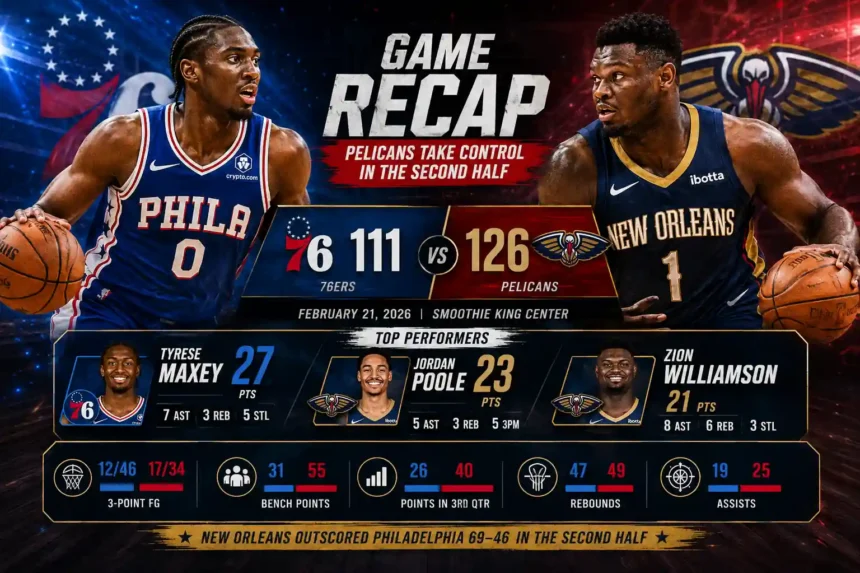
The latest 76ers vs New Orleans Pelicans match player stats show that New Orleans defeated Philadelphia 126–111 on February 21, 2026, at Smoothie King Center. Jordan Poole led the Pelicans with 23 points off the bench, while Zion Williamson produced 21 points, eight assists, six rebounds, and three steals. Tyrese Maxey scored a game-high 27 points for Philadelphia, but the Sixers could not overcome New Orleans’ 50% three-point shooting and dominant second half.
- 76ers vs New Orleans Pelicans Match Player Stats: Quick Summary
- Team Statistics Comparison
- Philadelphia 76ers Player Stats
- New Orleans Pelicans Player Stats
- How New Orleans Took Control of the Match
- Three-point shooting changed the result
- Jordan Poole delivered the decisive bench performance
- Zion Williamson influenced every part of the game
- DeAndre Jordan protected the rim
- Philadelphia 76ers Player Performance Analysis
- Tyrese Maxey produced numbers but lacked shooting efficiency
- Kelly Oubre Jr. provided Philadelphia’s cleanest scoring performance
- Philadelphia needed more from the supporting cast
- Quarter-by-Quarter Match Timeline
- Bench Production Was a Major Difference
- How the February Game Differed From the January Meeting
- Main Statistical Takeaways
- More Sports Profiles: Celtics vs New Orleans Pelicans match player stats
- Conclusion
- Frequently Asked Questions
- Who won the 76ers vs Pelicans game on February 21, 2026?
- Who was the leading scorer in the game?
- What were Tyrese Maxey’s stats against New Orleans?
- What were Zion Williamson’s stats against Philadelphia?
- Who had the most rebounds?
- Why did the Pelicans beat the 76ers?
- What was the biggest turning point?
- Did Philadelphia and New Orleans split the season series?
76ers vs New Orleans Pelicans Match Player Stats: Quick Summary
Philadelphia controlled much of the first half and carried a 65–57 lead into halftime. New Orleans changed the game after the break, winning the third quarter 40–26 and the fourth 29–20.
The Pelicans finished with a 69–46 second-half scoring advantage. They also outscored Philadelphia 60–35 over the final 21 minutes of the game.
| Match detail | Information |
| Date | February 21, 2026 |
| Venue | Smoothie King Center, New Orleans |
| Final score | Pelicans 126, 76ers 111 |
| Halftime score | 76ers 65, Pelicans 57 |
| Leading scorer | Tyrese Maxey, 27 points |
| Pelicans leading scorer | Jordan Poole, 23 points |
| Top rebounder | DeAndre Jordan, 15 rebounds |
| Top assist performance | Zion Williamson, 8 assists |
| Decisive quarter | Third quarter, Pelicans 40–26 |
The official NBA game book confirms the final score, individual numbers, starting lineups, inactive players, and period-by-period results.
Team Statistics Comparison
The largest difference came from outside shooting. Philadelphia attempted 46 three-pointers but converted only 12. New Orleans attempted 34 and made 17.
The Pelicans therefore made five more three-pointers despite taking 12 fewer attempts. Those five additional makes created a 15-point advantage from behind the arc—the exact final margin.
| Team statistic | Philadelphia 76ers | New Orleans Pelicans |
| Points | 111 | 126 |
| Field goals | 36–94 | 40–81 |
| Field-goal percentage | 38.3% | 49.4% |
| Three-pointers | 12–46 | 17–34 |
| Three-point percentage | 26.1% | 50.0% |
| Free throws | 27–33 | 29–38 |
| Player rebounds | 47 | 49 |
| Assists | 19 | 25 |
| Steals | 10 | 5 |
| Blocks | 5 | 8 |
| Player turnovers | 10 | 14 |
Philadelphia created more steals and recorded fewer player turnovers, but New Orleans compensated with superior shooting, ball movement, rim protection, and bench scoring.
Philadelphia 76ers Player Stats
Tyrese Maxey and Kelly Oubre Jr. combined for 52 points. The rest of Philadelphia’s rotation produced 59, and only four Sixers reached double figures.
| Player | MIN | PTS | REB | AST | FG | 3PT | +/- |
| Tyrese Maxey | 36:14 | 27 | 3 | 7 | 9–23 | 2–11 | -4 |
| Kelly Oubre Jr. | 33:17 | 25 | 5 | 2 | 7–15 | 4–10 | -7 |
| VJ Edgecombe | 35:19 | 14 | 5 | 3 | 5–14 | 1–5 | -16 |
| Dominick Barlow | 28:56 | 9 | 5 | 0 | 3–9 | 0–1 | -14 |
| Andre Drummond | 21:10 | 5 | 12 | 1 | 2–7 | 0–2 | -16 |
| Quentin Grimes | 25:48 | 11 | 1 | 3 | 3–9 | 2–7 | -16 |
| Jabari Walker | 16:23 | 9 | 6 | 1 | 3–5 | 2–3 | +5 |
| Cameron Payne | 13:07 | 5 | 0 | 1 | 2–7 | 1–6 | -6 |
| Adem Bona | 21:25 | 4 | 10 | 1 | 1–2 | 0–0 | +2 |
| Justin Edwards | 6:04 | 2 | 0 | 0 | 1–2 | 0–0 | -7 |
| Tyrese Martin | 2:17 | 0 | 0 | 0 | 0–1 | 0–1 | +4 |
Philadelphia played without Joel Embiid, who was listed as inactive in the official game report. Paul George was also inactive.
New Orleans Pelicans Player Stats
New Orleans received at least 10 points from eight players. That balance made it difficult for Philadelphia to concentrate its defense on one scorer.
| Player | MIN | PTS | REB | AST | FG | 3PT | +/- |
| Zion Williamson | 32:49 | 21 | 6 | 8 | 7–14 | 0–0 | +24 |
| Saddiq Bey | 26:54 | 20 | 4 | 2 | 7–14 | 4–7 | +3 |
| Herb Jones | 32:09 | 14 | 1 | 3 | 5–11 | 2–5 | +1 |
| Derik Queen | 20:53 | 10 | 9 | 0 | 2–5 | 1–1 | +1 |
| DeAndre Jordan | 31:30 | 6 | 15 | 0 | 2–3 | 0–0 | +13 |
| Jordan Poole | 24:28 | 23 | 3 | 5 | 8–15 | 5–11 | +21 |
| Bryce McGowens | 26:44 | 13 | 1 | 1 | 4–5 | 3–4 | +3 |
| Karlo Matkovic | 18:14 | 12 | 3 | 0 | 3–3 | 2–2 | 0 |
| Jeremiah Fears | 24:56 | 7 | 7 | 6 | 2–10 | 0–3 | +11 |
| Jordan Hawkins | 1:23 | 0 | 0 | 0 | 0–1 | 0–1 | -2 |
Poole, McGowens, and Matkovic combined for 48 bench points while shooting 15-of-23 from the field.
How New Orleans Took Control of the Match
Three-point shooting changed the result
Philadelphia’s offense produced enough three-point opportunities, but the shots did not fall consistently. The Sixers made 12 of 46 attempts, while the Pelicans converted exactly half of their 34 shots from long range.
The difference became especially damaging after halftime. Philadelphia missed 21 of its 24 second-half three-point attempts. That allowed New Orleans to turn an eight-point halftime deficit into a comfortable victory.
Saddiq Bey made four threes, Jordan Poole made five, Bryce McGowens added three, and both Herb Jones and Karlo Matkovic made two.
New Orleans did not depend on a single hot shooter. Multiple lineups maintained the same spacing and scoring threat.
Jordan Poole delivered the decisive bench performance
Poole scored 23 points in only 24 minutes and 28 seconds. He shot 8-of-15 overall and 5-of-11 from three while adding five assists and committing no turnovers.
His +21 plus-minus was the second-best mark in the game. Only Williamson finished higher.
Poole’s production was particularly important during New Orleans’ second-half surge. His pull-up shooting stretched Philadelphia’s defense, while his passing helped keep the ball moving when the Sixers attempted to pressure him.
His three-pointer with 5:20 remaining gave New Orleans a 120–99 lead and effectively ended Philadelphia’s comeback hopes.
Zion Williamson influenced every part of the game
Williamson did much more than score 21 points. He recorded eight assists, six rebounds, three steals, and one block while committing only one turnover.
He finished at +24, the best plus-minus of any player.
Philadelphia regularly sent extra defensive attention toward him in the paint. Williamson responded by finding perimeter shooters and cutters instead of forcing difficult attempts. His eight assists helped New Orleans finish with 25 as a team.
He also shot 7-of-8 from the free-throw line and converted seven of his 14 field-goal attempts. It was an efficient, controlled performance rather than a high-volume scoring display.
DeAndre Jordan protected the rim
DeAndre Jordan scored only six points, but his defensive and rebounding numbers were central to the result.
He collected a game-high 15 rebounds, including five offensive boards, and blocked four shots. New Orleans recorded eight blocks as a team.
Jordan’s interior presence made Philadelphia’s driving lanes more difficult to use. The Sixers were already struggling from outside, so losing efficiency around the basket placed even more pressure on their half-court offense.
His work also gave the Pelicans a reliable defensive rebounder while smaller guards and wings moved into transition.
Philadelphia 76ers Player Performance Analysis
Tyrese Maxey produced numbers but lacked shooting efficiency
Maxey led all players with 27 points and added seven assists and five steals. Those numbers show how active he remained at both ends.
However, he needed 23 field-goal attempts to score his 27 points. He made only two of 11 three-pointers and committed five turnovers.
The Pelicans were prepared to live with difficult pull-up threes rather than allow Maxey to attack an open lane. As Philadelphia’s outside shooting declined, New Orleans could place more defensive attention on his drives.
Maxey still reached the free-throw line eight times and made seven attempts, but Philadelphia needed greater efficiency from its main creator.
Kelly Oubre Jr. provided Philadelphia’s cleanest scoring performance
Oubre finished with 25 points, five rebounds, and two assists. He shot 7-of-15 from the field, made four three-pointers, and converted seven of eight free throws.
He also completed the game without a turnover.
His three-pointer at the halftime buzzer gave Philadelphia a 65–57 lead and completed a strong opening half for the visitors. Oubre continued scoring after the break, but the Sixers could not match New Orleans’ collective production.
Among Philadelphia’s major scorers, Oubre offered the best combination of efficiency, perimeter shooting, and ball security.
Philadelphia needed more from the supporting cast
VJ Edgecombe added 14 points, five rebounds, and three assists, but shot 5-of-14. Quentin Grimes scored 11 while shooting 3-of-9.
Dominick Barlow and Andre Drummond combined for only 14 points as starters. Drummond did contribute 12 rebounds, including six on the offensive glass.
Jabari Walker was one of the more productive reserves. He scored nine points on five attempts, grabbed six rebounds, and recorded a team-best +5 plus-minus.
Adem Bona also provided 10 rebounds and finished at +2, but Philadelphia’s bench was unable to match the Pelicans’ scoring depth.
Quarter-by-Quarter Match Timeline
| Quarter | 76ers | Pelicans | Quarter winner |
| First | 29 | 24 | Philadelphia +5 |
| Second | 36 | 33 | Philadelphia +3 |
| Third | 26 | 40 | New Orleans +14 |
| Fourth | 20 | 29 | New Orleans +9 |
Philadelphia began well and led 29–24 after the first quarter. It added 36 points in the second, with Maxey and Oubre helping the visitors take an eight-point halftime advantage.
The match changed in the third quarter. Philadelphia briefly pushed its lead into double figures, but New Orleans shot 12-of-16 during the period. The Pelicans scored 40 points and moved ahead 97–91.
New Orleans then opened the fourth quarter with a 23–8 run. Its lead reached 21 points at 120–99 with 5:20 remaining. Philadelphia never seriously threatened again.
Bench Production Was a Major Difference
New Orleans’ reserves outscored Philadelphia’s bench 55–31.
| Bench category | Philadelphia | New Orleans |
| Bench points | 31 | 55 |
| Double-figure bench scorers | 1 | 3 |
| Leading reserve | Quentin Grimes, 11 | Jordan Poole, 23 |
| Reserve three-pointers | 5 | 10 |
Philadelphia’s starters actually outscored the New Orleans starters 80–71. The Pelicans won because their second unit created a 24-point bench advantage.
Poole, McGowens, and Matkovic each reached double figures. The three also combined to make 10 of 17 three-point attempts.
That production allowed New Orleans to maintain offensive pressure when several starters rested. Philadelphia did not receive the same scoring lift from its reserves.
How the February Game Differed From the January Meeting
The teams also played on January 31, 2026, when Philadelphia won 124–114.
Joel Embiid dominated that first meeting with 40 points and 11 rebounds. Kelly Oubre Jr. added 19 points and 10 rebounds, while Tyrese Maxey scored 18. Saddiq Bey led New Orleans with 34 points.
The rematch had a very different shape:
| Season meeting | Winner | Main difference |
| January 31, 2026 | Philadelphia, 124–114 | Embiid scored 40 and controlled late possessions |
| February 21, 2026 | New Orleans, 126–111 | Pelicans made 17 threes and received 55 bench points |
Philadelphia had a reliable interior scoring option in the first game. In the rematch, Embiid was inactive, and the Sixers relied more heavily on perimeter attempts.
New Orleans also received a much more balanced scoring effort in February. Eight Pelicans reached double figures, compared with five in the January loss.
The two results show how lineup availability, shot selection, and bench depth can completely change the same matchup within a few weeks.
Main Statistical Takeaways
The 126–111 result can be explained through four numbers:
50%: New Orleans’ three-point percentage.
55: Points scored by the Pelicans’ bench.
40–26: New Orleans’ advantage in the third quarter.
+24: Zion Williamson’s game-best plus-minus.
Philadelphia remained competitive when Maxey and Oubre controlled the offense. The match shifted when the Sixers’ three-point shooting collapsed and New Orleans received scoring from several different lineups.
The Pelicans did not win through one exceptional individual scoring total. They won through shooting efficiency, bench balance, secondary playmaking, and interior defense.
More Sports Profiles: Celtics vs New Orleans Pelicans match player stats
Conclusion
The latest 76ers–Pelicans matchup was decided by more than the leading scorers. Maxey and Oubre combined for 52 points, but Philadelphia’s poor three-point efficiency and limited bench production left the team vulnerable. New Orleans received an all-around performance from Zion Williamson, a 23-point spark from Jordan Poole, four blocks and 15 rebounds from DeAndre Jordan, and double-figure scoring from eight players. The Pelicans’ 50% shooting from three and 55 bench points provide the clearest explanation for the 126–111 result. Philadelphia controlled the first half, but New Orleans’ depth, spacing, and second-half execution completely changed the match.
Frequently Asked Questions
Who won the 76ers vs Pelicans game on February 21, 2026?
The New Orleans Pelicans won 126–111 at Smoothie King Center. They overcame an eight-point halftime deficit by outscoring Philadelphia 69–46 in the second half.
Who was the leading scorer in the game?
Tyrese Maxey was the overall leading scorer with 27 points. Jordan Poole led New Orleans with 23 points off the bench.
What were Tyrese Maxey’s stats against New Orleans?
Maxey recorded 27 points, seven assists, three rebounds, and five steals. He shot 9-of-23 from the field, 2-of-11 from three, and 7-of-8 from the free-throw line.
What were Zion Williamson’s stats against Philadelphia?
Williamson finished with 21 points, eight assists, six rebounds, three steals, and one block. He shot 7-of-14 and recorded a game-high +24 plus-minus.
Who had the most rebounds?
DeAndre Jordan led the game with 15 rebounds. Andre Drummond led Philadelphia with 12, while Adem Bona added 10 from the bench.
Why did the Pelicans beat the 76ers?
New Orleans shot 50% from three, won the bench-scoring battle 55–31, produced 25 assists, and outscored Philadelphia by 23 points after halftime.
What was the biggest turning point?
The third quarter was decisive. New Orleans won it 40–26 after trailing 65–57 at halftime. The Pelicans then began the fourth with a 23–8 run.
Did Philadelphia and New Orleans split the season series?
Yes. Philadelphia won the January 31 meeting 124–114, while New Orleans won the February 21 rematch 126–111.