




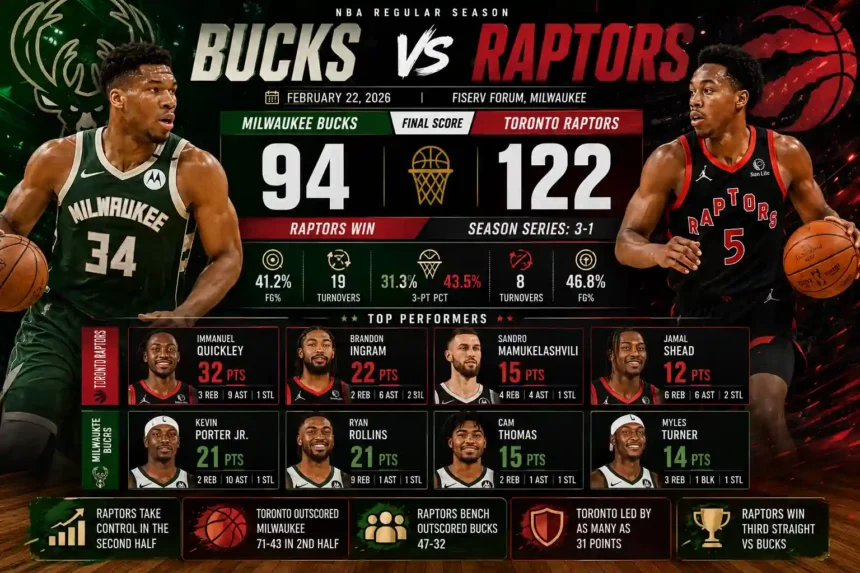
The latest Milwaukee Bucks vs Toronto Raptors match player stats show that Toronto earned a convincing 122–94 road victory on February 22, 2026. Immanuel Quickley led all players with 32 points and nine assists, while Brandon Ingram added 22 points and six assists. Milwaukee received 21 points each from Kevin Porter Jr. and Ryan Rollins, but the Bucks struggled with turnovers and inefficient three-point shooting. Toronto won the season series 3–1 after controlling the second half and building a lead that reached 31 points.
- Match Overview
- Top Player Statistics at a Glance
- Toronto Raptors Player Stats
- Immanuel Quickley: 32 Points and Nine Assists
- Brandon Ingram: Efficient Secondary Creation
- Sandro Mamukelashvili: Valuable Bench Scoring
- Jamal Shead: Two-Way Bench Impact
- Other Raptors Contributors
- Milwaukee Bucks Player Stats and Performance Review
- Kevin Porter Jr.: 21 Points and 10 Assists
- Ryan Rollins: 21 Points and Nine Rebounds
- Cam Thomas and Myles Turner
- Team Statistical Comparison
- Why Toronto Won the Game
- Better Ball Security
- Stronger Perimeter Shooting at Key Moments
- Quickley Controlled the Main Matchup
- Toronto Received More Complete Bench Production
- Defensive Pressure Disrupted Milwaukee
- The Game’s Most Important Turning Point
- How Giannis Antetokounmpo’s Absence Affected Milwaukee
- Milwaukee Bucks vs Toronto Raptors Season-Series Results
- Most Impressive Individual Performances
- Best Overall Performance: Immanuel Quickley
- Best Milwaukee Performance: Kevin Porter Jr.
- Best Supporting Performance: Jamal Shead
- Most Efficient Toronto Scoring Performance: Quickley
- Main Takeaways from the Player Stats
- More Sports Profiles: Carolina Panthers vs 49ers match player stats
- Conclusion
- Frequently Asked Questions
- Who won the latest Bucks vs Raptors game?
- Who scored the most points in the game?
- Who led the Milwaukee Bucks in scoring?
- What were Immanuel Quickley’s full stats?
- Why did the Bucks lose to the Raptors?
- Did Giannis Antetokounmpo play against Toronto?
- Who had the most assists?
- Who won the 2025–26 season series?
Match Overview
| Game detail | Information |
| Matchup | Toronto Raptors vs Milwaukee Bucks |
| Date | February 22, 2026 |
| Venue | Fiserv Forum, Milwaukee |
| Final score | Raptors 122, Bucks 94 |
| Leading scorer | Immanuel Quickley, 32 points |
| Largest reported Toronto lead | 31 points |
| Season-series result | Toronto won 3–1 |
Toronto overcame an encouraging Milwaukee start before taking control during the second quarter. The Raptors led 60–51 at halftime, extended the advantage to 92–73 after three quarters and comfortably closed the game in the fourth.
The victory was Toronto’s third consecutive win over Milwaukee and gave the Raptors a 3–1 advantage in the four-game regular-season series.
Top Player Statistics at a Glance
| Player | Team | Points | Rebounds | Assists | Key note |
| Immanuel Quickley | Raptors | 32 | 3 | 9 | Hit five three-pointers |
| Brandon Ingram | Raptors | 22 | 2 | 6 | Added two blocks |
| Sandro Mamukelashvili | Raptors | 15 | 4 | 4 | Strong bench impact |
| Jamal Shead | Raptors | 12 | 6 | 6 | Recorded two steals |
| Kevin Porter Jr. | Bucks | 21 | 2 | 10 | Milwaukee’s leading playmaker |
| Ryan Rollins | Bucks | 21 | 9 | 1 | Nearly recorded a double-double |
| Cam Thomas | Bucks | 15 | — | — | Third-leading Milwaukee scorer |
| Myles Turner | Bucks | 14 | — | — | Added frontcourt scoring |
Quickley produced the most influential performance. He combined efficient scoring with controlled playmaking and committed only one turnover. Porter and Rollins kept Milwaukee competitive during parts of the first half, but the Bucks did not receive enough efficient production across the rotation.
Toronto Raptors Player Stats
Immanuel Quickley: 32 Points and Nine Assists
Quickley delivered the standout performance of the game:
| Statistic | Total |
| Minutes | 31 |
| Points | 32 |
| Rebounds | 3 |
| Assists | 9 |
| Steals | 1 |
| Field goals | 11-of-19 |
| Three-pointers | 5-of-11 |
| Free throws | 5-of-5 |
| Turnovers | 1 |
| Plus/minus | +12 |
He shot 57.9% from the field and 45.5% from three-point range. His 32 points came with excellent ball security, giving Toronto both high-volume scoring and dependable possession management.
Quickley was especially damaging when Milwaukee attempted to regain momentum. After the Bucks opened the third quarter with an 8–2 run, Quickley helped Toronto answer immediately and restore control.
Brandon Ingram: Efficient Secondary Creation
Ingram provided 22 points, six assists, two rebounds and two blocks in 31 minutes. He made eight of 17 field-goal attempts, two three-pointers and four free throws.
Although Quickley was Toronto’s leading scorer, Ingram gave the Raptors another dependable creator. His six assists prevented Milwaukee from loading its defense toward one ball handler, while his two blocks added value at the other end.
His ability to score and facilitate helped Toronto maintain offensive balance rather than relying entirely on one player.
Sandro Mamukelashvili: Valuable Bench Scoring
Mamukelashvili scored 15 points in only 23 minutes. He also collected four rebounds, handed out four assists and recorded one steal.
He shot six of 12 from the field and three of eight from beyond the arc. His plus-22 rating was one of the clearest signs of Toronto’s bench advantage.
The former Milwaukee player stretched the floor, moved the ball and helped the Raptors increase their lead while several starters rested.
Jamal Shead: Two-Way Bench Impact
Shead finished with:
- 12 points
- Six rebounds
- Six assists
- Two steals
- Four made field goals
- A game-high plus-26 rating
His performance was about more than scoring. Shead pressured Milwaukee’s guards, helped Toronto move the ball and contributed on the defensive glass.
Toronto did not lose its structure when Quickley went to the bench because Shead continued to create shots and defend aggressively.
Other Raptors Contributors
Jakob Poeltl scored six points, collected eight rebounds and added two steals while making three of four shots.
RJ Barrett had a difficult shooting performance, finishing with seven points on two-of-10 shooting. However, he still contributed six rebounds, three assists and two steals.
Ja’Kobe Walter added nine points, six rebounds and three assists. Collin Murray-Boyles produced eight points, four rebounds and two steals in 20 minutes.
Toronto therefore received useful contributions even from players who were not major scorers. That balance helped the team absorb an inefficient night from Barrett and the absence of Scottie Barnes.
Milwaukee Bucks Player Stats and Performance Review
Kevin Porter Jr.: 21 Points and 10 Assists
Porter was Milwaukee’s leading playmaker. He recorded 21 points and 10 assists, giving him a points-assists double-double.
His ability to create off the dribble helped Milwaukee score early, but the Bucks’ wider offensive problems reduced the value of his production. Toronto’s perimeter pressure forced Milwaukee into difficult possessions and limited the team’s three-point efficiency.
Porter’s 10 assists were still one of the strongest individual numbers in the game and showed that Milwaukee created some quality opportunities despite the final margin.
Ryan Rollins: 21 Points and Nine Rebounds
Rollins matched Porter with 21 points and added nine rebounds. He was Milwaukee’s most productive rebounding guard and finished one board short of a double-double.
Rollins gave the Bucks scoring energy, but Toronto prevented his production from developing into a sustained team run. Milwaukee needed another high-level scoring option once the Raptors began trapping, switching and recovering more effectively around the perimeter.
Cam Thomas and Myles Turner
Cam Thomas scored 15 points, making him Milwaukee’s third-leading scorer. Myles Turner followed with 14.
Both reached double figures, but neither performance was large enough to offset Toronto’s more complete scoring distribution. The Raptors had four players score at least 12 points and received stronger two-way contributions from their reserves.
Milwaukee’s supporting scorers also had to operate without Giannis Antetokounmpo, which changed the spacing, shot hierarchy and pressure placed on Toronto’s interior defense.
Team Statistical Comparison
| Team statistic | Raptors | Bucks |
| Points | 122 | 94 |
| Field-goal percentage | 46.8% | 41.2% |
| Turnovers | 8 | 19 |
| Halftime score | 60 | 51 |
| Third-quarter score | 32 | 22 |
| Season-series wins | 3 | 1 |
Toronto’s 46.8% shooting was good rather than extraordinary. The decisive difference was that the Raptors protected the ball and generated more productive possessions.
Milwaukee committed 19 turnovers, compared with only eight for Toronto. That 11-turnover difference repeatedly prevented the Bucks from establishing offensive rhythm and gave the Raptors additional transition chances.
Why Toronto Won the Game
Better Ball Security
The Raptors committed only eight turnovers. Milwaukee committed 19.
A team can survive a modest shooting difference, but it becomes much harder to compete when it also gives away 11 additional possessions. Toronto’s guards made controlled decisions and rarely allowed Milwaukee to create easy points from live-ball mistakes.
Quickley was the best example. He generated nine assists while committing only one turnover. That gave him an outstanding assist-to-turnover ratio and allowed Toronto to maintain control of the tempo.
Stronger Perimeter Shooting at Key Moments
Milwaukee made only five of 16 three-point attempts in the first half. The Bucks then went two of eight from deep during the third quarter.
Toronto, by comparison, connected on six of 11 three-point attempts in the third. That was the period in which the Raptors transformed a manageable halftime advantage into a 19-point lead.
The final margin was not created by one brief scoring burst. It developed because Toronto repeatedly answered Milwaukee’s runs with cleaner execution and more accurate perimeter shooting.
Quickley Controlled the Main Matchup
Quickley scored efficiently at all three levels. He made shots from beyond the arc, converted at the free-throw line and created opportunities for teammates.
Milwaukee could not simply force the ball out of his hands because Ingram, Mamukelashvili and Shead were also creating or finishing possessions. Quickley therefore dictated the game without needing to dominate every shot attempt.
His 32 points were important, but the combination of 32 points, nine assists and one turnover made the performance especially valuable.
Toronto Received More Complete Bench Production
Mamukelashvili and Shead combined for 27 points, 10 rebounds, 10 assists and three steals.
Their plus/minus totals of plus-22 and plus-26 reflected Toronto’s control during bench-heavy stretches. The Raptors did not simply protect the lead when their starters rested; they frequently increased it.
A postgame analysis also credited Toronto with a 47–32 bench-scoring advantage.
Defensive Pressure Disrupted Milwaukee
Toronto’s perimeter defense made it difficult for Milwaukee to enter actions comfortably. The Bucks committed six turnovers in the third quarter alone and made only two of eight three-point attempts in that period.
Milwaukee started the second half with energy and cut into the deficit, but Toronto answered with a 10–0 run. From that point, the Raptors controlled the remaining minutes and eventually led by as many as 31.
The Game’s Most Important Turning Point
Milwaukee began the third quarter with an 8–2 run, reducing Toronto’s lead and forcing a Raptors timeout.
That appeared to be the moment when the Bucks might turn the game into a close fourth-quarter contest. Instead, Toronto responded with 10 consecutive points. Quickley and Shead scored five each during the run.
The response showed the difference between the teams. Milwaukee needed considerable effort to reduce the deficit, while Toronto quickly created high-quality shots and forced new turnovers to restore control.
By the end of the third quarter, the Raptors led 92–73.
How Giannis Antetokounmpo’s Absence Affected Milwaukee
Giannis Antetokounmpo did not play because of a calf injury. His absence removed Milwaukee’s primary interior scorer, transition threat and defensive problem-solver.
Porter and Rollins responded with 21 points each, but the Bucks lacked the same pressure at the rim. Toronto’s defenders could focus more heavily on perimeter actions without consistently needing to collapse around Giannis.
His absence does not fully explain 19 turnovers or poor three-point shooting, but it significantly changed Milwaukee’s offensive structure and placed greater responsibility on the guard rotation.
Toronto was also without Scottie Barnes, so neither team entered the matchup with its full preferred lineup. The Raptors adjusted more successfully because Quickley, Ingram and the bench maintained a balanced offensive approach.
Milwaukee Bucks vs Toronto Raptors Season-Series Results
The teams met four times during the 2025–26 regular season:
| Date | Result |
| October 24, 2025 | Bucks 122, Raptors 116 |
| November 4, 2025 | Raptors 128, Bucks 100 |
| December 18, 2025 | Raptors victory |
| February 22, 2026 | Raptors 122, Bucks 94 |
Milwaukee won the opening meeting, but Toronto responded with three consecutive victories to claim the series 3–1.
The series changed after the opening game. Toronto became more successful at disrupting Milwaukee’s ball handlers and received increasingly balanced production across its lineup.
The final matchup was the most decisive result of the series and confirmed Toronto’s statistical advantage over Milwaukee during the season.
Most Impressive Individual Performances
Best Overall Performance: Immanuel Quickley
Quickley was the clear player of the game. His 32 points led all scorers, while his nine assists helped Toronto maintain balanced production.
His combination of shooting efficiency, playmaking and ball security separated him from every other player.
Best Milwaukee Performance: Kevin Porter Jr.
Porter’s 21 points and 10 assists gave Milwaukee its strongest combination of scoring and creation.
Although the Bucks lost comfortably, Porter continued generating opportunities and finished as the only Milwaukee player with double-digit assists.
Best Supporting Performance: Jamal Shead
Shead’s 12 points, six rebounds, six assists and two steals made him the game’s most complete reserve.
His plus-26 rating was the highest among the listed Toronto players and demonstrated how strongly the Raptors performed during his minutes.
Most Efficient Toronto Scoring Performance: Quickley
Quickley posted a 75.5% true-shooting mark, made five three-pointers and converted every free throw.
He needed only 19 field-goal attempts to score 32 points, making his performance both productive and efficient.
Main Takeaways from the Player Stats
The Milwaukee Bucks vs Toronto Raptors match player stats reveal five clear conclusions:
- Quickley was the game’s dominant scorer and most effective creator.
- Toronto’s eight turnovers were a major advantage over Milwaukee’s 19.
- Porter and Rollins produced strong individual numbers without enough team support.
- Toronto’s bench had a major influence through Mamukelashvili and Shead.
- The Raptors adapted better to missing a star player and controlled the final three quarters.
The final 28-point margin reflected more than hot shooting. Toronto passed more effectively, defended with greater pressure and made fewer costly mistakes.
More Sports Profiles: Carolina Panthers vs 49ers match player stats
Conclusion
The Milwaukee Bucks vs Toronto Raptors match player stats tell the story of a game decided by efficient guard play, ball security, and bench depth. Quickley led Toronto with 32 points and nine assists, while Ingram supplied another 22 points. Mamukelashvili and Shead strengthened the second unit, allowing the Raptors to maintain pressure throughout the game. Milwaukee received productive performances from Porter and Rollins, but 19 turnovers and weak perimeter shooting prevented the Bucks from sustaining their early momentum. Toronto responded to every attempted comeback, controlled the second half, and completed a 3–1 season-series victory with a decisive 122–94 result.
Frequently Asked Questions
Who won the latest Bucks vs Raptors game?
The Toronto Raptors defeated the Milwaukee Bucks 122–94 on February 22, 2026, at Fiserv Forum in Milwaukee.
Who scored the most points in the game?
Immanuel Quickley led all scorers with 32 points. He also recorded nine assists, three rebounds and one steal.
Who led the Milwaukee Bucks in scoring?
Kevin Porter Jr. and Ryan Rollins shared Milwaukee’s scoring lead with 21 points each. Porter added 10 assists, while Rollins collected nine rebounds.
What were Immanuel Quickley’s full stats?
Quickley recorded 32 points, nine assists, three rebounds and one steal. He made 11 of 19 field-goal attempts, five of 11 three-pointers and all five of his free throws.
Why did the Bucks lose to the Raptors?
Milwaukee struggled because of 19 turnovers, 41.2% field-goal shooting and inconsistent three-point scoring. Toronto committed only eight turnovers and shot 46.8% from the field.
Did Giannis Antetokounmpo play against Toronto?
No. Giannis missed the game because of a calf injury. His absence reduced Milwaukee’s interior scoring, transition pressure and defensive versatility.
Who had the most assists?
Kevin Porter Jr. led the game with 10 assists. Quickley followed with nine, while Ingram and Shead recorded six each.
Who won the 2025–26 season series?
Toronto won the season series 3–1. Milwaukee took the first meeting, but the Raptors won the next three games.