



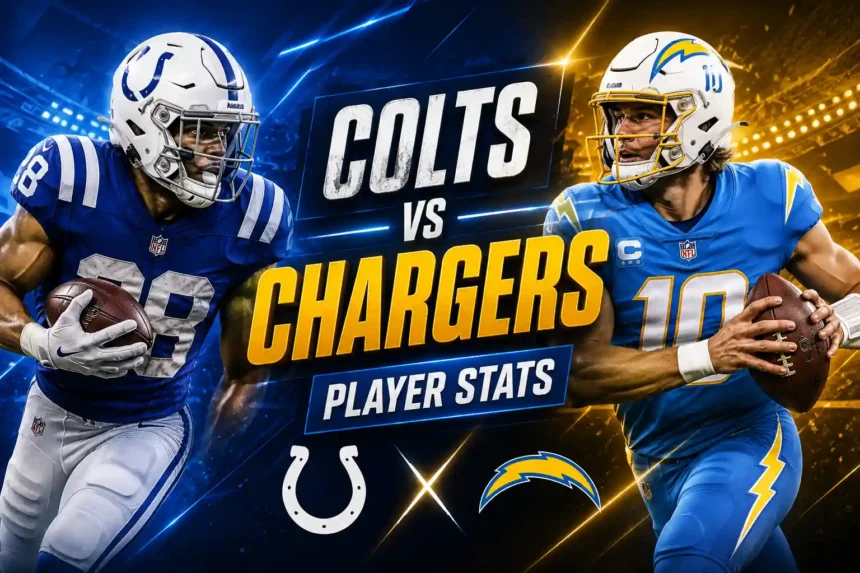
The Colts vs Chargers match player stats tell the story of a game in which efficiency mattered more than total yardage. Indianapolis defeated Los Angeles 38–24 at SoFi Stadium on October 19, 2025. Jonathan Taylor scored three rushing touchdowns, Daniel Jones threw two touchdown passes without an interception, and the Colts defense forced two crucial turnovers. Justin Herbert passed for 420 yards, but Los Angeles spent most of the game trying to recover from a 23–3 halftime deficit. vs Chargers match summary
- Key Colts vs Chargers match player stats
- Jonathan Taylor was the game’s most influential player
- Daniel Jones delivered efficiency instead of empty volume
- Justin Herbert’s 420 yards came with costly turnovers
- Oronde Gadsden II produced a breakout performance
- Defensive players who changed the result
- Quarter-by-quarter Colts vs Chargers scoring breakdown
- First quarter: Indianapolis establishes the run
- Second quarter: The Colts take control
- Third quarter: Both offenses accelerate
- Fourth quarter: Indianapolis protects the lead
- Why the Colts won despite having fewer total yards
- 1. Indianapolis created a 20-point halftime lead
- 2. The turnover margin was 2–0
- 3. Jonathan Taylor finished drives
- 4. Indianapolis produced more explosive efficiency
- 5. The Colts answered every third-quarter challenge
- 6. Special teams created a short field
- 7. Indianapolis made the decisive late defensive plays
- What the box score does not immediately show
- Fantasy football and individual-performance takeaways
- What this result showed about both teams
- Conclusion
- Frequently asked questions
- What was the final Colts vs Chargers score?
- Who had the best Colts vs Chargers match player stats?
- How many passing yards did Justin Herbert record?
- How did Daniel Jones perform against the Chargers?
- Who led the game in receiving yards?
- Why did the Chargers lose despite gaining more yards?
- How many touchdowns did Jonathan Taylor score?
- Which defensive players made the biggest difference?
| Game detail | Information |
| Matchup | Indianapolis Colts at Los Angeles Chargers |
| Date | October 19, 2025 |
| Week | NFL Week 7 |
| Venue | SoFi Stadium, Inglewood, California |
| Final score | Colts 38, Chargers 24 |
| Halftime score | Colts 23, Chargers 3 |
| Colts record after game | 6–1 |
| Chargers record after game | 4–3 |
| Leading scorer | Jonathan Taylor, three touchdowns |
| Leading passer | Justin Herbert, 420 yards |
| Leading receiver | Oronde Gadsden II, 164 yards |
Indianapolis scored on its first three offensive possessions and built a 20-point halftime advantage. Los Angeles found more success after the break, scoring three second-half touchdowns, but the Colts answered both of the Chargers’ third-quarter touchdown drives.
That ability to respond prevented the game from becoming a close fourth-quarter contest.
Key Colts vs Chargers match player stats
The headline numbers present two very different types of quarterback performance.
Daniel Jones operated a balanced, efficient Indianapolis attack. Justin Herbert carried a pass-heavy Chargers offense that generated impressive yardage but also produced two interceptions.
| Player | Team | Key statistics |
| Daniel Jones | Colts | 23/34, 288 passing yards, 2 TD, 0 INT |
| Jonathan Taylor | Colts | 16 carries, 94 yards, 3 TD |
| Alec Pierce | Colts | 5 receptions, 98 yards |
| Tyler Warren | Colts | 4 receptions, 69 yards, 1 TD |
| Michael Pittman Jr. | Colts | 7 receptions, 58 yards, 1 TD |
| Justin Herbert | Chargers | 37/55, 420 passing yards, 3 TD, 2 INT |
| Oronde Gadsden II | Chargers | 7 receptions, 164 yards, 1 TD |
| Keenan Allen | Chargers | 11 receptions, 119 yards, 1 TD |
| Ladd McConkey | Chargers | 9 receptions, 67 yards |
| Quentin Johnston | Chargers | 2 receptions, 30 yards, 1 TD |
Jones finished with a 113.4 passer rating, while Herbert recorded a 93.0 rating. The difference was not completion percentage—both quarterbacks completed approximately 67 percent of their passes. The difference was ball security, scoring efficiency and game situation. ete Indianapolis Colts offensive player stats
Colts passing
| Player | Completions/attempts | Yards | Touchdowns | Interceptions | Passer rating |
| Daniel Jones | 23/34 | 288 | 2 | 0 | 113.4 |
Jones completed 67.6 percent of his throws and averaged approximately 8.5 yards per attempt. He was sacked only once and avoided the type of negative play that could have allowed Los Angeles to change the game’s direction.
Colts rushing
| Player | Carries | Yards | Average | Long | Touchdowns |
| Jonathan Taylor | 16 | 94 | 5.9 | 23 | 3 |
| Ameer Abdullah | 2 | 19 | 9.5 | 14 | 0 |
| Daniel Jones | 5 | 7 | 1.4 | 7 | 0 |
| Team total | 23 | 120 | 5.2 net average | 23 | 3 |
Taylor did not need 25 or 30 carries to control the game. Indianapolis consistently created favorable running lanes, particularly near the end zone. His touchdown runs covered 23, eight and 19 yards.
All three runs were important because each answered a different game situation. The first established Indianapolis’ early advantage. The second responded immediately after Los Angeles scored to begin the third quarter. The third restored a 21-point lead after another Chargers touchdown.
Colts receiving
| Player | Receptions | Targets | Yards | Average | Long | TD |
| Alec Pierce | 5 | 10 | 98 | 19.6 | 48 | 0 |
| Tyler Warren | 4 | 5 | 69 | 17.3 | 29 | 1 |
| Michael Pittman Jr. | 7 | 9 | 58 | 8.3 | 16 | 1 |
| Jonathan Taylor | 3 | 3 | 38 | 12.7 | 19 | 0 |
| Ameer Abdullah | 1 | 1 | 8 | 8.0 | 8 | 0 |
| Adonai Mitchell | 1 | 1 | 8 | 8.0 | 8 | 0 |
| Mo Alie-Cox | 1 | 2 | 6 | 6.0 | 6 | 0 |
| Anthony Gould | 1 | 1 | 3 | 3.0 | 3 | 0 |
Alec Pierce led Indianapolis in receiving yards even though Michael Pittman Jr. caught more passes. Pierce supplied the vertical element, including a 48-yard completion on third-and-17 during a major first-half drive.
Pittman worked as the dependable possession receiver. He caught seven of nine targets, scored on a four-yard pass and added the successful two-point reception following Taylor’s second touchdown.
Warren provided another matchup problem. The tight end caught four of five targets for 69 yards, including a 29-yard gain on Indianapolis’ opening drive and a five-yard touchdown in the second quarter. ete Los Angeles Chargers offensive player stats
Chargers passing
| Player | Completions/attempts | Yards | Touchdowns | Interceptions | Passer rating |
| Justin Herbert | 37/55 | 420 | 3 | 2 | 93.0 |
Herbert’s 420 passing yards were a career high at the time. He also added 31 rushing yards, meaning he personally generated most of the Chargers’ offensive production.
However, the volume requires context. Los Angeles ran 74 offensive plays and attempted 55 passes because the team was behind by 20 points at halftime. Herbert’s yardage reflects both strong quarterback play and the game script that forced the Chargers to throw repeatedly.
Chargers rushing
| Player | Carries | Yards | Average | Long | Touchdowns |
| Justin Herbert | 6 | 31 | 5.2 | 11 | 0 |
| Kimani Vidal | 9 | 20 | 2.2 | 5 | 0 |
| Hassan Haskins | 1 | 3 | 3.0 | 3 | 0 |
| Team total | 16 | 54 | 3.4 net average | 11 | 0 |
The Chargers’ lack of a productive conventional running game made their offense easier to read. Vidal managed only 20 yards on nine attempts, and Herbert finished as the team’s leading rusher.
Indianapolis did not have to respect the run in the same way Los Angeles had to respect Taylor. That imbalance became especially important in the red zone and during obvious passing situations.
Chargers receiving
| Player | Receptions | Targets | Yards | Average | Long | TD |
| Oronde Gadsden II | 7 | 9 | 164 | 23.4 | 53 | 1 |
| Keenan Allen | 11 | 14 | 119 | 10.8 | 30 | 1 |
| Ladd McConkey | 9 | 15 | 67 | 7.4 | 15 | 0 |
| Quentin Johnston | 2 | 6 | 30 | 15.0 | 23 | 1 |
| Tre Harris | 2 | 2 | 23 | 11.5 | 14 | 0 |
| Kimani Vidal | 4 | 5 | 15 | 3.8 | 8 | 0 |
| Hassan Haskins | 2 | 2 | 2 | 1.0 | 2 | 0 |
| Will Dissly | 0 | 1 | 0 | 0.0 | 0 | 0 |
Gadsden and Allen became the center of the passing attack. Together, they produced 18 receptions, 283 yards and two touchdowns.
McConkey received a game-high 15 targets but was largely limited to shorter gains. His 67 yards produced an average of only 7.4 yards per catch. That contrast demonstrates how Indianapolis allowed some underneath completions while trying to limit immediate scoring plays.
Jonathan Taylor was the game’s most influential player
The most important individual performance in the colts vs chargers match player stats belongs to Jonathan Taylor.
His rushing total of 94 yards was not the highest yardage figure in the game, but his three touchdowns directly shaped the score. He averaged 5.9 yards per carry and added three catches for 38 yards, giving him 132 yards from scrimmage.
Taylor scored Indianapolis’ first touchdown on a 23-yard run. The play completed a five-play, 75-yard opening drive and immediately established the Colts’ physical advantage.
His next two touchdowns were even more significant from a momentum perspective.
Los Angeles opened the second half with a 70-yard touchdown drive, cutting the score to 23–10. Indianapolis then received an 81-yard kickoff return from Ameer Abdullah. Taylor scored from eight yards out two plays later, and Pittman caught the two-point conversion.
The Chargers answered with another touchdown drive to make it 31–17. Taylor responded again, scoring on a 19-yard run less than three minutes later.
Each time Los Angeles appeared ready to create pressure, Taylor restored Indianapolis’ control.
Daniel Jones delivered efficiency instead of empty volume
Jones’ numbers were lower than Herbert’s, but his performance was better suited to winning this particular game.
He completed 23 of 34 attempts for 288 yards, two touchdowns and no interceptions. His 113.4 rating reflected accurate passing, strong decision-making and efficient downfield production.
The Colts averaged eight net yards per pass play, compared with the Chargers’ 6.7. Indianapolis therefore gained more value from each passing opportunity, even though Los Angeles accumulated more total passing yards. so distributed the ball effectively. Four Indianapolis players gained at least 38 receiving yards, and three produced at least 58.
His two touchdown passes came in the second quarter:
- A four-yard pass to Michael Pittman Jr.
- A five-yard pass to Tyler Warren
Jones did not need to force throws into coverage because the rushing attack, pass protection and receiver spacing kept the offense ahead of the required down-and-distance.
That balance was one of the biggest differences between the teams.
Justin Herbert’s 420 yards came with costly turnovers
Herbert’s performance cannot be reduced to the two interceptions. He completed 37 passes, threw three touchdowns and repeatedly created offense while facing a large deficit.
His connection with Gadsden was especially productive. Herbert also helped Los Angeles score touchdowns on three consecutive second-half drives.
Nevertheless, the interceptions occurred at the worst possible stage of the game.
The first came in the second quarter when a pass was tipped near the line. The second happened in the end zone with Los Angeles threatening to score before halftime.
Nick Cross secured the end-zone interception, and Indianapolis converted the extra possession into a 36-yard field goal as the first half expired. Instead of cutting the deficit, the Chargers entered halftime behind 23–3. s final line therefore represents both his ability and the difficulty of the situation. He generated 420 passing yards, but two empty first-half possessions placed Los Angeles in a hole that even three second-half touchdown passes could not erase.
Oronde Gadsden II produced a breakout performance
Gadsden was the Chargers’ clearest positive.
The rookie tight end caught seven of nine targets for 164 yards and one touchdown. He averaged 23.4 yards per reception, recorded a 53-yard gain and produced the first 100-yard receiving game of his career.
At that point, the 164-yard total was the fourth-highest single-game receiving figure by a tight end in Chargers franchise history. His 15-yard fourth-quarter touchdown was also the first touchdown of his NFL career. s performance stood out because he attacked Indianapolis at multiple levels. He produced gains of 22, 30 and 53 yards while also becoming a red-zone option.
For Los Angeles, the result was disappointing. For Gadsden’s development, however, the game represented a major step forward.
Defensive players who changed the result
The raw box score shows that the Colts allowed 445 total yards. That might suggest a poor defensive performance, but situational defense changed the game.
Grover Stewart
Stewart recorded the first Indianapolis interception when a Herbert pass was deflected at the line. The turnover stopped a promising Chargers possession in the second quarter.
Nick Cross
Cross produced the most valuable takeaway. His end-zone interception prevented Los Angeles from scoring shortly before halftime and gave Indianapolis time to add three more points.
DeForest Buckner
Buckner recorded two sacks on the Chargers’ final serious possession. His second brought a 12-yard loss when Los Angeles had moved near the red zone with approximately four minutes remaining.
That sack contributed to a turnover on downs and effectively ended the comeback attempt. tu Latu
Latu added another sack, giving Indianapolis three as a team.
The Colts defense did not dominate every snap. It succeeded by winning the game’s highest-leverage moments: two first-half takeaways and two late Buckner sacks.
Quarter-by-quarter Colts vs Chargers scoring breakdown
First quarter: Indianapolis establishes the run
Taylor opened the scoring with a 23-yard touchdown run. Michael Badgley missed the extra point, leaving Indianapolis ahead 6–0.
Cameron Dicker answered with a 43-yard field goal, but that became the Chargers’ only score of the first half.
Score after first quarter: Colts 6, Chargers 3
Second quarter: The Colts take control
Jones finished a 17-play, 70-yard drive with a four-yard touchdown pass to Pittman. The drive was particularly damaging because Indianapolis converted three fourth downs.
Jones later found Warren for a five-yard score, extending the advantage to 20–3.
After Cross intercepted Herbert in the end zone, Indianapolis moved 62 yards and added Badgley’s 36-yard field goal as time expired.
Halftime score: Colts 23, Chargers 3
Third quarter: Both offenses accelerate
Herbert opened the half with a seven-yard touchdown pass to Johnston.
Indianapolis answered almost immediately. Abdullah’s 81-yard kickoff return created a short field, Taylor scored from eight yards, and Jones connected with Pittman for a two-point conversion.
Herbert then led another long drive and found Allen for a four-yard touchdown. Once again, Taylor responded, this time with a 19-yard score.
Score after third quarter: Colts 38, Chargers 17
Fourth quarter: Indianapolis protects the lead
Herbert threw a 15-yard touchdown pass to Gadsden early in the quarter, cutting the deficit to 14 points.
The Chargers later constructed a 21-play drive that lasted more than nine minutes. The drive reached Indianapolis territory, but Buckner’s sacks helped create a fourth-and-27 situation.
Los Angeles failed to convert, and Indianapolis used the remaining time to close the game.
Final score: Colts 38, Chargers 24 statistics comparison
| Category | Colts | Chargers |
| Points | 38 | 24 |
| Total yards | 401 | 445 |
| Net passing yards | 281 | 391 |
| Rushing yards | 120 | 54 |
| First downs | 24 | 25 |
| Total plays | 58 | 74 |
| Yards per play | 6.9 | 6.0 |
| Third-down conversions | 5/11 | 8/16 |
| Fourth-down conversions | 3/3 | 3/4 |
| Red-zone touchdowns | 4/5 | 3/4 |
| Turnovers | 0 | 2 |
| Time of possession | 25:33 | 34:27 |
| Penalties | 3 for 42 yards | 6 for 35 yards |
These team totals explain why the final score may initially appear surprising.
Los Angeles had more yards, first downs, plays and possession time. Indianapolis had more points because it gained more yards per play, ran the ball more effectively and avoided turnovers.
Why the Colts won despite having fewer total yards
1. Indianapolis created a 20-point halftime lead
Los Angeles spent the second half operating with little room for error. The Chargers could no longer remain patient with the running game and had to rely heavily on Herbert.
That produced yardage but also made the offense more predictable.
2. The turnover margin was 2–0
Indianapolis did not give the ball away. Los Angeles threw two interceptions.
The Colts converted Cross’ interception into a field goal, while both turnovers prevented potential Chargers points.
3. Jonathan Taylor finished drives
Taylor transformed productive possessions into touchdowns. Los Angeles moved the ball through the air, but passing yards did not provide the same direct scoring value as Taylor’s three rushing touchdowns.
4. Indianapolis produced more explosive efficiency
The Colts averaged 6.9 yards per offensive play despite running 16 fewer plays.
Jones averaged more net yards per passing attempt than Herbert, while Taylor and the Indianapolis rushing attack averaged considerably more than the Chargers’ running backs.
5. The Colts answered every third-quarter challenge
Los Angeles scored two third-quarter touchdowns. Indianapolis responded with two Taylor touchdowns of its own.
The Chargers therefore used significant energy and clock without reducing the deficit.
6. Special teams created a short field
Abdullah’s 81-yard kickoff return immediately followed Los Angeles’ first touchdown. Indianapolis needed only two plays to answer.
That sequence prevented the Chargers from building momentum and restored a three-score advantage.
7. Indianapolis made the decisive late defensive plays
Buckner’s two fourth-quarter sacks stopped the Chargers’ final meaningful possession. Los Angeles held the ball for more than nine minutes on the drive but came away without points.
What the box score does not immediately show
Box scores provide results, but they do not always show when those results occurred.
Herbert’s 420 yards look more impressive than Jones’ 288. In isolation, that might suggest Herbert controlled the game. In reality, much of the Chargers’ passing production came after Indianapolis had built a commanding advantage.
Similarly, the Chargers’ 34:27 possession time appears positive. However, their final extended drive consumed more than nine minutes and ended on downs. Holding the ball only matters when the possession produces points.
Taylor’s 94 rushing yards may look relatively modest beside Herbert’s passing total or Gadsden’s 164 receiving yards. His three touchdowns, however, gave Indianapolis 18 points before extra points and made him the game’s most decisive offensive player.
The most useful reading of the Colts vs Chargers match player stats therefore combines production with timing, field position, turnovers and score differential.
Fantasy football and individual-performance takeaways
Jonathan Taylor
Taylor’s three touchdowns made him the top fantasy performer among Indianapolis skill-position players. His receiving contribution also strengthened his all-purpose value.
The performance demonstrated that touchdown opportunity and offensive-line execution may matter as much as raw carry volume.
Daniel Jones
Jones delivered an efficient fantasy result with 288 passing yards and two touchdowns. He did not throw an interception and added a small rushing contribution.
His value came from efficiency rather than unusually high passing volume.
Justin Herbert
Herbert’s three touchdowns and 420 passing yards created a strong fantasy total despite the interceptions.
From a real-game perspective, the turnovers were damaging. From a fantasy perspective, the volume and yardage compensated for much of that loss.
Oronde Gadsden II
Gadsden’s 164 yards and touchdown made him the breakout fantasy story. His nine targets also mattered because they suggested a meaningful role rather than production from one isolated play.
Keenan Allen
Allen remained Herbert’s most reliable high-volume target, catching 11 of 14 passes for 119 yards and a touchdown.
Alec Pierce
Pierce narrowly missed 100 yards and led Indianapolis with 98. His 19.6-yard average showed his value as the offense’s primary downfield threat.
What this result showed about both teams
For Indianapolis, the game demonstrated the value of a balanced attack. Jones did not have to match Herbert pass for pass because Taylor, the offensive line and the defense contributed in complementary ways.
The Colts could score through the run, complete passes downfield, convert short-yardage situations and create takeaways.
For Los Angeles, the game showed that explosive passing statistics cannot always compensate for an ineffective rushing attack and early turnovers.
The Chargers displayed resilience after halftime. Herbert, Gadsden and Allen created several major plays, and the offense scored on three consecutive second-half drives. The problem was that Indianapolis had already established too much control.
The final score was not the result of Los Angeles being unable to move the football. It was the result of Indianapolis making better use of its possessions.
Conclusion
The Colts vs Chargers match player stats show why football games cannot be judged by total yardage alone. Los Angeles passed for 420 yards through Herbert and finished with 445 total yards. Gadsden and Allen both exceeded 100 receiving yards. Those were significant individual achievements. Indianapolis still played the more complete game. Jones protected the football and threw two touchdowns. Taylor scored three times. The Colts converted every fourth-down attempt, generated more rushing production, created two interceptions and repeatedly answered Los Angeles’ second-half scores.
The result came down to efficiency in the moments that mattered most. Indianapolis turned its opportunities into a 38–24 victory, while Los Angeles accumulated impressive numbers without overcoming the damage created by its first-half mistakes.
Frequently asked questions
What was the final Colts vs Chargers score?
Indianapolis defeated Los Angeles 38–24 on October 19, 2025, at SoFi Stadium. The Colts led 23–3 at halftime and improved to 6–1 with the victory.
Who had the best Colts vs Chargers match player stats?
Jonathan Taylor had the most influential performance. He rushed 16 times for 94 yards and three touchdowns while adding three receptions for 38 yards.
How many passing yards did Justin Herbert record?
Herbert completed 37 of 55 passes for 420 yards, three touchdowns and two interceptions. It was a career-high passing total at the time.
How did Daniel Jones perform against the Chargers?
Jones completed 23 of 34 attempts for 288 yards and two touchdowns. He did not throw an interception and finished with a 113.4 passer rating.
Who led the game in receiving yards?
Oronde Gadsden II led all receivers with 164 yards. He caught seven passes, recorded a 53-yard gain and scored a 15-yard touchdown.
Why did the Chargers lose despite gaining more yards?
Los Angeles committed two turnovers, rushed for only 54 yards and entered halftime behind 23–3. Indianapolis committed no turnovers, averaged more yards per play and scored three rushing touchdowns.
How many touchdowns did Jonathan Taylor score?
Taylor scored three touchdowns. His scoring runs covered 23, eight and 19 yards.
Which defensive players made the biggest difference?
Nick Cross and Grover Stewart recorded interceptions, while DeForest Buckner produced two crucial fourth-quarter sacks. Laiatu Latu also registered a sack.