




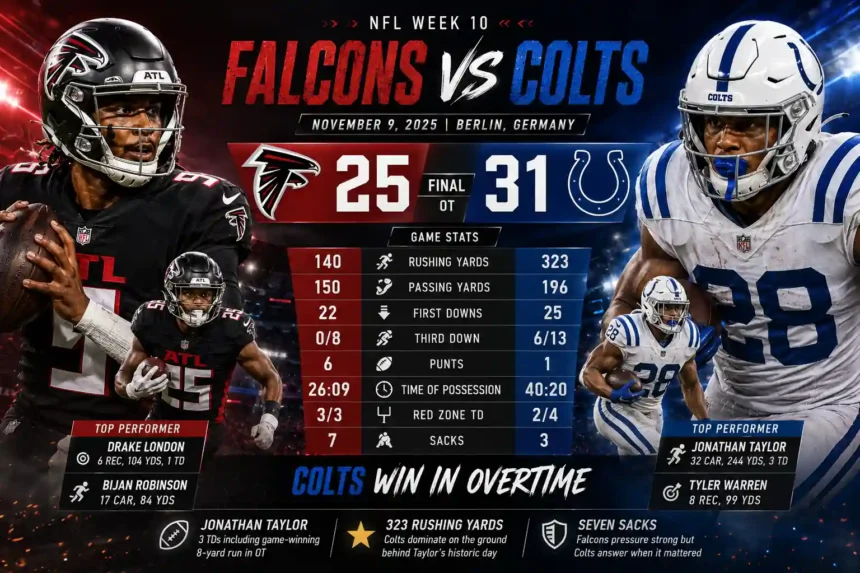
The Indianapolis Colts defeated the Atlanta Falcons 31-25 in overtime on November 9, 2025, at Olympic Stadium in Berlin. Jonathan Taylor delivered the defining performance, rushing 32 times for 244 yards and three touchdowns, including an 83-yard fourth-quarter score and the game-winning eight-yard run in overtime. Atlanta remained competitive behind Drake London, Bijan Robinson, Tyler Allgeier, and a seven-sack defensive performance, but the Falcons could not overcome Indianapolis’ 323 rushing yards or their own 0-for-8 result on third down.
- Game Overview
- Final Score by Quarter
- Complete Scoring Timeline
- Atlanta Falcons vs Colts Match Player Stats at a Glance
- Jonathan Taylor Produced the Decisive Performance
- Quarterback Comparison: Daniel Jones vs. Michael Penix Jr.
- Rushing Production Beyond Taylor
- Receiving Leaders for Indianapolis
- Drake London Led Atlanta’s Passing Attack
- Atlanta’s Seven Sacks Were Not Enough
- Indianapolis’ Defense Delivered in High-Leverage Moments
- Team Statistics That Explain the Result
- Why the Indianapolis Colts Won
- 1. Jonathan Taylor Controlled the Game
- 2. Indianapolis Created More Explosive Plays
- 3. Atlanta Failed on Third Down
- 4. Special Teams Helped Indianapolis Recover
- 5. Indianapolis Executed Better in Overtime
- What Atlanta Did Well
- Main Takeaways from the Player Stats
- Conclusion
- Frequently Asked Questions
- Who won the Atlanta Falcons vs. Colts game?
- What were Jonathan Taylor’s stats against Atlanta?
- What were Michael Penix Jr.’s passing stats?
- How did Daniel Jones perform for the Colts?
- Who was Atlanta’s leading receiver?
- Who led the Colts in receiving yards?
- How many sacks did the Falcons record?
- Why did Atlanta lose despite recording seven sacks?
Game Overview
| Game detail | Information |
| Matchup | Atlanta Falcons vs. Indianapolis Colts |
| Date | November 9, 2025 |
| Competition | 2025 NFL regular season, Week 10 |
| Venue | Olympic Stadium, Berlin, Germany |
| Final score | Colts 31, Falcons 25 |
| Result | Indianapolis won in overtime |
| Attendance | 72,203 |
| Atlanta record afterward | 3-6 |
| Indianapolis record afterward | 8-2 |
The contest was the first regular-season NFL game played in Berlin. Indianapolis entered the day looking to recover from its Week 9 defeat, while Atlanta was attempting to stop a three-game losing streak. The Colts improved to 8-2, while the Falcons suffered their fourth consecutive loss and fell to 3-6.
Final Score by Quarter
| Team | Q1 | Q2 | Q3 | Q4 | OT | Final |
| Atlanta Falcons | 7 | 7 | 3 | 8 | 0 | 25 |
| Indianapolis Colts | 13 | 0 | 0 | 12 | 6 | 31 |
The quarter-by-quarter totals show how unusual the game was. Indianapolis scored 13 points in the opening quarter, went scoreless through the next two periods, and then produced 18 points across the fourth quarter and overtime. Atlanta held leads of 14-13, 17-13, and 25-22, but it could not protect the final advantage.
Complete Scoring Timeline
Indianapolis opened the scoring after safety Cam Bynum stripped Michael Penix Jr. The short field allowed Jonathan Taylor to score from one yard, although Michael Badgley missed the extra point.
Atlanta responded with a one-yard Tyler Allgeier touchdown and moved ahead 7-6. The Colts needed little time to reclaim the lead. Daniel Jones connected with Alec Pierce for a 37-yard touchdown, giving Indianapolis a 13-7 advantage.
The Falcons controlled the second quarter. Penix found Drake London for a 16-yard touchdown with 3:25 remaining, sending Atlanta into halftime with a 14-13 lead.
Zane Gonzalez extended that advantage to 17-13 with a 43-yard field goal in the third quarter. Indianapolis did not move back in front until the fourth.
Badgley made a 34-yard field goal to reduce the margin to one point. Taylor then broke through Atlanta’s defense for an 83-yard touchdown run. The failed two-point conversion left Indianapolis ahead 22-17.
Atlanta answered with a late touchdown drive. Allgeier scored his second one-yard touchdown, and Penix completed a pass to London for the two-point conversion. The Falcons led 25-22 with 1:44 remaining.
Indianapolis used a 49-yard Ameer Abdullah kickoff return, a 19-yard Jones scramble and Badgley’s 44-yard field goal to force overtime with 25 seconds left.
Atlanta received the ball first in overtime but was forced to punt. Indianapolis then advanced into scoring territory before Taylor ended the contest with an eight-yard touchdown run.
Atlanta Falcons vs Colts Match Player Stats at a Glance
| Player | Team | Category | Performance |
| Jonathan Taylor | Colts | Rushing | 32 carries, 244 yards, 3 TDs |
| Daniel Jones | Colts | Passing | 19/26, 255 yards, 1 TD, 1 INT |
| Tyler Warren | Colts | Receiving | 8 catches, 99 yards |
| Alec Pierce | Colts | Receiving | 4 catches, 84 yards, 1 TD |
| Michael Penix Jr. | Falcons | Passing | 12/28, 177 yards, 1 TD, 0 INT |
| Bijan Robinson | Falcons | Rushing | 17 carries, 84 yards |
| Tyler Allgeier | Falcons | Rushing | 11 carries, 57 yards, 2 TDs |
| Drake London | Falcons | Receiving | 6 catches, 104 yards, 1 TD |
| Xavier Watts | Falcons | Defense | 11 total tackles |
| Zaire Franklin | Colts | Defense | 10 total tackles, 1 sack |
The individual numbers immediately identify Taylor as the game’s central figure. However, Tyler Warren, Alec Pierce, Jones, London, Allgeier and Atlanta’s defensive front all made contributions that shaped the overtime finish.
Jonathan Taylor Produced the Decisive Performance
Taylor accounted for 244 of Indianapolis’ 323 rushing yards. That means he generated more than three-quarters of the Colts’ production on the ground while averaging 7.6 yards per carry.
He also caught all three of his targets for 42 yards, raising his total to 286 yards from scrimmage. His rushing total alone exceeded Atlanta’s entire offensive output on the ground by 104 yards.
The timing of his touchdowns made the performance even more valuable.
His first score gave Indianapolis an early lead. His 83-yard touchdown reversed the game in the fourth quarter after Atlanta had controlled much of the middle two periods. His third touchdown ended the contest in overtime.
The 83-yard run was the longest rushing attempt of Taylor’s career at that point. It also gave him his 65th career rushing touchdown, moving him ahead of Edgerrin James for the Colts’ franchise record. Taylor then increased the record to 66 with his overtime score.
Taylor’s performance was not simply a product of one long run. Even without the 83-yard touchdown, he would have finished with 161 yards on 31 carries. That works out to more than five yards per attempt on the rest of his workload.
His combination of consistency and explosiveness forced Atlanta to defend every section of the field. When the Falcons committed extra resources to the run, Indianapolis could use play-action or attack outside matchups. When Atlanta played more cautiously, Taylor continued collecting efficient gains.
Quarterback Comparison: Daniel Jones vs. Michael Penix Jr.
| Statistic | Daniel Jones | Michael Penix Jr. |
| Completions/attempts | 19/26 | 12/28 |
| Completion rate | 73.1% | 42.9% |
| Passing yards | 255 | 177 |
| Passing touchdowns | 1 | 1 |
| Interceptions | 1 | 0 |
| Sacks taken | 7 | 3 |
| Passer rating | 100.6 | 76.0 |
Jones produced the more efficient passing performance. He completed 19 of 26 attempts, averaged 9.8 yards per attempt and finished with a passer rating of 100.6. Penix completed only 12 of 28 passes and struggled to maintain drives outside Atlanta’s successful red-zone possessions.
Jones’ performance was not mistake-free. Atlanta intercepted him once, forced multiple fumbles and recorded seven sacks for 59 lost yards. Those negative plays prevented Indianapolis from building on its early advantage and helped the Falcons remain ahead for much of the second half.
His response to those mistakes mattered. On Indianapolis’ final fourth-quarter possession, Jones recovered from another sack by scrambling for 19 yards. That play kept the drive alive and helped set up the tying field goal.
Penix protected the football through the air and threw a well-placed touchdown to London, but his overall efficiency was too low. Atlanta’s passing game produced only 150 net yards after accounting for sacks.
The problem was particularly visible when Penix targeted receivers other than London. Darnell Mooney was targeted eight times but finished with one reception for 17 yards. Kyle Pitts caught two of five targets for 38 yards.
Penix also began the game with a lost fumble and could not produce a first down on Atlanta’s overtime possession. Zaire Franklin’s sack helped end that drive and allowed the Colts to win with any score.
Rushing Production Beyond Taylor
Indianapolis finished with 323 rushing yards on 41 attempts, an average of 7.9 yards per carry. Jones contributed 53 yards on seven attempts, including his critical late scramble. Ashton Dulin added a 22-yard run, and Tyler Goodson gained four yards on his only carry.
Atlanta’s backfield was productive in a smaller role. Bijan Robinson gained 84 yards on 17 attempts, averaging 4.9 yards per carry. Allgeier added 57 yards and two touchdowns on 11 attempts.
Together, Robinson and Allgeier produced 141 yards before Penix’s negative one-yard carry reduced Atlanta’s team total to 140.
The Falcons’ running backs were effective enough to support a balanced offense, but the team could not keep them on the field. Atlanta ran only 29 rushing plays compared with Indianapolis’ 41. Failed third downs and the Colts’ long possessions reduced the number of opportunities available to Robinson and Allgeier.
Allgeier’s role near the goal line was especially effective. Both of his touchdowns came from one yard, allowing Atlanta to finish all three of its red-zone opportunities with touchdowns.
Receiving Leaders for Indianapolis
Tyler Warren
Tyler Warren led the Colts with eight receptions for 99 yards on 10 targets. His 23-yard catch in overtime moved Indianapolis into Atlanta territory and helped establish the drive that Taylor eventually finished.
Warren did not score, but he functioned as Jones’ most dependable possession receiver. His eight receptions were twice as many as any other Colts player recorded.
Alec Pierce
Pierce supplied the vertical threat. He caught four of seven targets for 84 yards, averaging 21 yards per reception.
His 37-yard touchdown in the first quarter came through tight coverage and restored Indianapolis’ lead shortly after Atlanta had moved ahead. It remained the Colts’ only passing touchdown of the game.
Jonathan Taylor
Taylor’s 42 receiving yards should not be overlooked. His three receptions included a 24-yard gain, and he caught every pass thrown in his direction.
Michael Pittman Jr., Ameer Abdullah and Josh Downs combined for only 30 receiving yards, making the production from Warren, Pierce and Taylor essential.
Drake London Led Atlanta’s Passing Attack
London recorded six catches for 104 yards and a touchdown on eight targets. He was responsible for nearly 59% of Penix’s passing yards and caught half of Atlanta’s completed passes.
His 16-yard touchdown gave the Falcons their halftime lead. Late in regulation, he caught the two-point conversion that moved Atlanta ahead 25-22.
London was the only Falcons player with more than two receptions. Pitts finished with two catches for 38 yards, while Mooney, Charlie Woerner and Robinson combined for four catches and 35 yards.
This concentration made Atlanta’s passing offense predictable. When the Colts limited London or forced Penix toward secondary options, the Falcons struggled to create completions.
Mooney’s one catch on eight targets was particularly damaging. Some incompletions resulted from pressure or difficult coverage rather than the receiver alone, but seven unsuccessful targets represented too many lost opportunities in a six-point overtime defeat.
Atlanta’s Seven Sacks Were Not Enough
The Falcons produced one of their strongest pass-rushing performances of the season. Seven different defenders recorded one sack:
| Falcons defender | Sacks | Sack yards |
| James Pearce Jr. | 1 | 18 |
| Jalon Walker | 1 | 11 |
| Arnold Ebiketie | 1 | 11 |
| Kaden Elliss | 1 | 10 |
| Ronnie Harrison | 1 | 6 |
| Brandon Dorlus | 1 | 2 |
| Zach Harrison | 1 | 1 |
The seven sacks were Atlanta’s highest single-game total since 2018, and having seven different players record them established a franchise high. Jessie Bates III also intercepted Jones, while the Falcons recovered one Indianapolis fumble.
The pressure disrupted the Colts’ passing game, but it did not solve the main defensive problem. Indianapolis repeatedly compensated for sacks through Taylor’s rushing gains, Jones’ scrambles, explosive completions and strong return yardage.
Sacks are valuable because they create long-yardage situations. Their impact declines when the offense immediately recovers the lost yardage or receives favorable field position on the next possession.
That pattern appeared on the drive that tied the game. Atlanta sacked Jones, but he answered with a 19-yard scramble. Indianapolis remained in field-goal range, and Badgley made the tying kick.
Xavier Watts led Atlanta with 11 total tackles. Bates added nine total tackles along with his interception, while Ronnie Harrison and David Onyemata each recorded seven. The high tackle totals also reflected the amount of time Atlanta’s defense spent on the field.
Indianapolis’ Defense Delivered in High-Leverage Moments
The Colts recorded only three sacks, but two came at especially valuable times.
Bynum’s first-quarter strip sack created the short field for Taylor’s opening touchdown. Franklin’s overtime sack helped stop Atlanta’s first possession of the extra period.
Nick Cross recorded the third Indianapolis sack. Franklin finished with six solo tackles, four assists and a sack, giving him a team-high 10 total tackles.
Sauce Gardner contributed six total tackles and an important pass breakup during an Atlanta third-quarter possession. Bynum added five tackles to his sack and forced fumble.
Indianapolis did not intercept Penix. Instead, the defense won through situational execution: creating one early turnover, forcing six punts, stopping every Atlanta third-down attempt and producing a three-and-out in overtime.
Team Statistics That Explain the Result
| Team statistic | Falcons | Colts |
| First downs | 22 | 25 |
| Rushing attempts-yards | 29-140 | 41-323 |
| Net passing yards | 150 | 196 |
| Total net yards | 290 | 519 |
| Sacks allowed | 3 | 7 |
| Punts | 6 | 1 |
| Penalties-yards | 3-35 | 7-56 |
| Field goals | 1/1 | 2/3 |
| Red-zone efficiency | 3/3 | 2/4 |
| Time of possession | 26:09 | 40:20 |
Indianapolis accumulated 229 more net yards than Atlanta. Nearly all of that difference came from the ground game, where the Colts held a 183-yard advantage.
Atlanta’s red-zone efficiency explains why the game remained close. The Falcons scored touchdowns on all three trips inside the Indianapolis 20-yard line, while the Colts converted only two of four red-zone opportunities.
Efficiency near the goal line allowed Atlanta to produce 25 points from 290 net yards. It was an impressive example of finishing drives, but it was not sustainable without more possession time and third-down success.
The Colts held the ball for 40:20, more than 14 minutes longer than Atlanta. That advantage enabled Indianapolis to run 41 times, wear down the Falcons’ defense and continue feeding Taylor late in the contest.
Atlanta’s six punts compared with one by Indianapolis show the difference between the offenses. Even after sacks, turnovers and missed kicks stalled some Colts drives, Indianapolis generally advanced the ball before a possession ended.
Why the Indianapolis Colts Won
1. Jonathan Taylor Controlled the Game
The simplest explanation is also the strongest. Atlanta did not contain Taylor.
He produced short-yardage touchdowns, efficient carries between the tackles, receiving yards and the longest play of the game. His 83-yard score instantly erased Atlanta’s advantage, while his overtime touchdown prevented the Falcons from getting another possession.
2. Indianapolis Created More Explosive Plays
The Colts entered the matchup as one of the NFL’s strongest teams at generating gains of 10 or more yards. Atlanta allowed seven such plays in the first quarter alone—the most the Falcons had allowed in any first quarter that season.
Taylor’s 83-yard run and Pierce’s 37-yard touchdown were the most visible examples. Warren, Jones and the return units added further gains that changed field position.
3. Atlanta Failed on Third Down
The Falcons went 0-for-8 on third down. That prevented them from extending possessions even when Robinson, Allgeier and London were playing effectively.
Atlanta had converted only eight of 40 third downs across its previous four losses after the Indianapolis game, a 20% success rate. Against the Colts specifically, the failure to convert any third down left the defense exposed to too many Indianapolis possessions.
4. Special Teams Helped Indianapolis Recover
Indianapolis received 70 kick-return yards from Dulin and 69 from Abdullah. Dulin had a 50-yard return, while Abdullah’s 49-yard return started the drive that produced the tying field goal.
Those returns reduced the distance Jones and the offense needed to travel. They were especially valuable because the Colts had already missed an extra point and a 53-yard field goal.
5. Indianapolis Executed Better in Overtime
Atlanta’s overtime possession ended without a first down. Franklin’s sack contributed to the stop, and the Falcons punted the ball back to Indianapolis.
The Colts then needed seven plays to score. Warren delivered a key reception, Taylor continued generating positive runs, and Indianapolis completed the game without facing another serious setback.
What Atlanta Did Well
The final Atlanta Falcons vs Colts match player stats should not be interpreted as a completely one-sided performance.
Atlanta protected the football through the air, scored touchdowns on all three red-zone trips and generated seven sacks with seven different defenders. London exceeded 100 receiving yards, Robinson averaged nearly five yards per carry, and Allgeier scored twice.
The Falcons also recovered from an early strip sack and a 13-7 deficit to lead at halftime. After Taylor’s 83-yard touchdown, they responded with an eight-point drive rather than allowing Indianapolis to close the game immediately.
Those positives show why Atlanta remained within one play of winning despite being outgained by 229 yards.
The problem was consistency between scoring opportunities. Atlanta did not convert a third down, punted six times and completed only 42.9% of its passes. Strong red-zone execution kept the Falcons close, but the offense did not sustain enough drives to protect the defense or control the clock.
Main Takeaways from the Player Stats
Jonathan Taylor was the clear player of the game. His 244 rushing yards, 42 receiving yards, and three touchdowns drove nearly every important Indianapolis scoring phase.
Daniel Jones balanced efficiency with resilience. He absorbed seven sacks and committed two turnovers, but still completed 73.1% of his passes, generated 255 passing yards and made a crucial late scramble.
Drake London gave Atlanta a reliable receiving option. His 104 yards, touchdown and two-point conversion accounted for a major share of Atlanta’s passing success.
The Falcons’ defensive pressure was real but incomplete. Seven sacks disrupted Jones, yet Indianapolis’ rushing attack prevented that pressure from deciding the game.
Third downs and possession time separated the teams. Atlanta’s 0-for-8 third-down performance contributed directly to Indianapolis’ 40:20 possession advantage.
Special teams changed the late-game field position. Abdullah’s 49-yard return helped Indianapolis reach tying-field-goal range before overtime.
Conclusion
The Atlanta Falcons vs Colts match player stats tell the story of a game decided by rushing dominance, explosive plays and situational execution.
Atlanta produced seven sacks, three red-zone touchdowns and strong performances from London, Robinson and Allgeier. Indianapolis nevertheless controlled the game’s physical and statistical foundation. The Colts rushed for 323 yards, held the ball for more than 40 minutes and received a historic performance from Taylor.
His 244 rushing yards and three touchdowns were the headline numbers, but the complete explanation includes Warren’s reliable receiving, Pierce’s deep touchdown, Jones’ late scramble, Indianapolis’ kickoff returns and Franklin’s overtime sack.
Atlanta had several opportunities to secure the result. Its inability to convert third downs or stop Taylor eventually mattered more than its pass rush and red-zone efficiency. Indianapolis capitalized on those weaknesses and completed a 31-25 overtime victory in Berlin.
Frequently Asked Questions
Who won the Atlanta Falcons vs. Colts game?
The Indianapolis Colts defeated the Atlanta Falcons 31-25 in overtime. Taylor scored the winning touchdown on an eight-yard run with 3:31 remaining in the overtime period.
What were Jonathan Taylor’s stats against Atlanta?
Taylor recorded 32 rushing attempts for 244 yards and three touchdowns. He also caught three passes for 42 yards, giving him 286 yards from scrimmage.
What were Michael Penix Jr.’s passing stats?
Penix completed 12 of 28 attempts for 177 yards, one touchdown and no interceptions. He was sacked three times and lost one fumble.
How did Daniel Jones perform for the Colts?
Jones completed 19 of 26 passes for 255 yards, one touchdown and one interception. He also rushed seven times for 53 yards but was sacked seven times and lost one fumble.
Who was Atlanta’s leading receiver?
London led the Falcons with six receptions for 104 yards and one touchdown. He also caught the two-point conversion that gave Atlanta a 25-22 lead late in the fourth quarter.
Who led the Colts in receiving yards?
Warren led Indianapolis with eight receptions for 99 yards. Pierce finished second with 84 yards and scored the Colts’ only receiving touchdown.
How many sacks did the Falcons record?
Atlanta recorded seven sacks. Seven different Falcons defenders produced one sack each, making the performance notable for both its total and the number of contributors.
Why did Atlanta lose despite recording seven sacks?
Atlanta could not stop Indianapolis’ rushing offense, which generated 323 yards. The Falcons also went 0-for-8 on third down, were outgained 519-290 and possessed the ball for only 26:09.